Roof Area Visual Diagram
Enter your dimensions and pitch to see how slope increases the actual roof surface above the flat footprint.
The metal roof calculator will calculate the total material needed, panel count, roofing squares and installation cost based on your building dimensions, roof pitch and panel type. The calculator works on any smartphone or tablet without the need to download an app. It produces figures that are the same as those used by contractors and metal roof suppliers when pricing a project, so you can compare any estimate you receive with an independent figure.
What Is a Metal Roof and What Does This Calculator Measure?
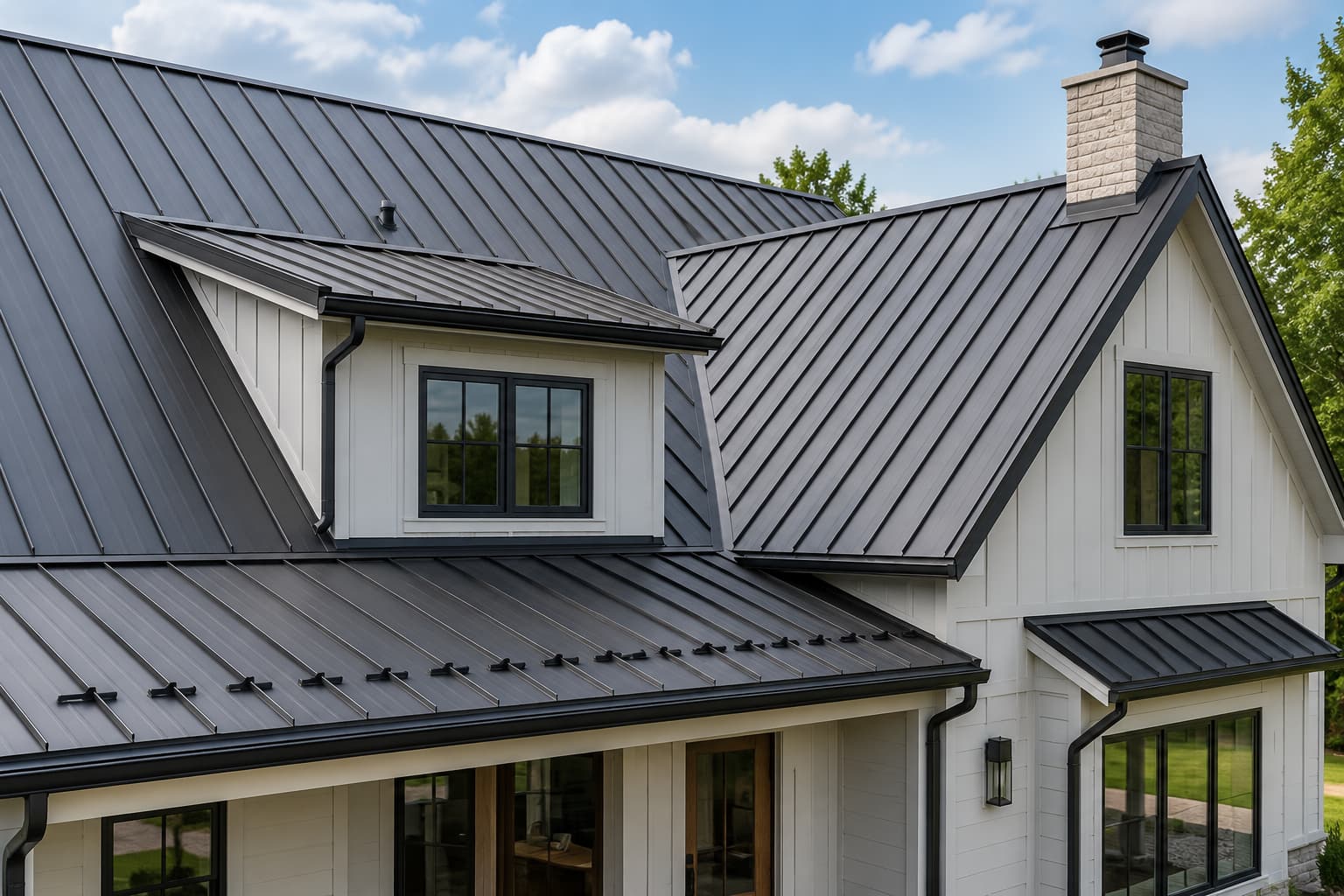
A metal roof is defined as a roofing system made from steel, aluminum, copper, or zinc panels or shingles installed over a structural roof deck, designed to last 40 to 70 years or more depending on the material and coating. Before using this tool, calculate your total roof surface with our Roof Area Calculator. The calculator then converts your roof area into roofing squares, panel quantities, and estimated material costs based on 2026 pricing.
How Does the Metal Roof Calculator Work?
The calculator multiplies the base footprint of your building by a pitch correction factor to account for the additional surface area created by the roof slope. The correction factor bridges the gap between a flat roof and a steeply pitched roof on the same footprint If you do not know your roof slope, use our Roof Pitch Calculator before calculating metal roofing materials.
The formula is: Actual Roof Area = Base Footprint Area multiplied by the square root of one plus the result of dividing the roof rise by 12, then squaring that result. This is consistent with NRCA estimating references and IRC Section R905 material application guidance from the International Code Council.
What Inputs Does the Calculator Need?
Building length and width are measured at the base in feet. Use the exterior wall measurements, not the interior living area, since the roof extends past the interior walls.
Eave overhang is the distance the roof extends past the exterior wall on each side. The average residential overhang is between 12 and 18 inches. Omitting this input will underestimate your material order.The calculator applies a standard 12-inch eave overhang by default. Select Advanced Options to enter a different measurement if your roof overhangs differ from this standard.
Roof pitch is expressed as rise over run, such as 4:12 or 6:12. A 4:12 pitch means the roof rises 4 inches for every 12 inches of horizontal run. Our Roof Pitch Calculator can help you measure your pitch from the attic or outside. Most residential metal roofs fall between 3:12 and 12:12, though standing seam panels can be installed as low as a quarter inch per foot under IRC R905.10.2.
Metal panel type determines the coverage rate per panel and the material cost per square. Standing seam, corrugated, and exposed fastener panels all have different coverage widths and pricing tiers.
Roof Type Roof type tells the calculator which waste factor to apply automatically. Gable roofs use 10 percent, hip roofs use 15 percent, and mansard roofs use 18 percent.
What Are the Common Types of Metal Roofing Panels?
| Panel Type | Typical Coverage Width | Common Pitch Range | Material Cost per Square (2026) |
| Standing seam (hidden fastener) | 12 to 18 inches | 1:12 and above | $600 to $1,200 |
| Corrugated (exposed fastener) | 26 to 36 inches | 3:12 and above | $300 to $600 |
| Metal shingle or shake | 12 to 16 inches per panel | 3:12 and above | $400 to $900 |
| Stone-coated steel | 4 sq ft per tile | 2:12 and above | $350 to $700 |
| Ribbed R-panel (pole barn) | 36 inches | 1:12 and above | $250 to $500 |
Standing seam is a popular choice for residential installation because its hidden fastener design eliminates exposed screws that can leak or back out over time. R-panel and corrugated panels are the standard choice for pole barn metal roofing and agricultural structures where installed cost per square foot is the primary driver.
How Do I Calculate Metal Roof Square Footage Step by Step?
This example uses a simple gable roof. The house is 45 feet long and 32 feet wide, with a 1-foot eave overhang on all four sides and a roof pitch of 5:12.
Step 1: Adjust for the overhang. Add 1 foot to each end of both dimensions. Adjusted length is 47 feet, adjusted width is 34 feet. Base footprint is 47 multiplied by 34, which equals 1,598 square feet.
Step 2: Find the pitch correction factor. For a 5:12 pitch, the factor is approximately 1.083.
Step 3: Multiply. 1,598 multiplied by 1.083 equals approximately 1,731 square feet of actual roof surface.
Step 4: Add waste. Metal roofing typically requires a 10 percent waste allowance. 1,731 multiplied by 1.10 equals 1,904 square feet to order.
Step 5: Convert to roofing squares. 1,904 divided by 100 equals approximately 19 roofing squares.
A 1,598 square foot base footprint at a 5:12 pitch with standard waste requires approximately 19 roofing squares of metal panel material.
Pitch Correction Factor Table for Metal Roofing
| Pitch | Angle | Correction Factor | Area Added Over Flat |
| 1:12 | 4.8° | 1.003 | +0.3% |
| 2:12 | 9.5° | 1.014 | +1.4% |
| 3:12 | 14.0° | 1.031 | +3.1% |
| 4:12 | 18.4° | 1.054 | +5.4% |
| 5:12 | 22.6° | 1.083 | +8.3% |
| 6:12 | 26.6° | 1.118 | +11.8% |
| 8:12 | 33.7° | 1.202 | +20.2% |
| 10:12 | 39.8° | 1.302 | +30.2% |
| 12:12 | 45.0° | 1.414 | +41.4% |
A 12:12 pitch roof requires 41.4 percent more metal panel material than the same building's horizontal footprint, which is why steep roofs cost significantly more than low-slope installations.
How Do I Calculate Metal Roof Area for a Hip Roof?
A hip roof has four sloped sides instead of two, which means you cannot use a single length-by-width footprint calculation the way you would for a simple gable. Divide the hip roof into its individual triangular and trapezoidal sections, calculate the area of each section using its own base dimension and pitch, then add all sections together before applying the waste factor.
For a standard hip roof on a rectangular building that is 50 feet long and 36 feet wide with a uniform 6:12 pitch, the two trapezoidal sides each have a base equal to the building length minus the hip run at each end, and the two triangular ends each have a base equal to the building width. Calculate each section's footprint area independently, sum them, then multiply the total by 1.118, the 6:12 correction factor.
Hip roofs require a minimum 15 percent waste factor because every panel running toward a hip line must be cut at an angle, which wastes more material per panel than a straight ridge cut on a gable. Using a 10 percent waste factor on a hip roof will almost always leave you short.
How Do I Use This Calculator for a Pole Barn Metal Roof?
A pole barn metal roof calculation follows the same base formula as any other structure, with two differences that matter at the ordering stage. Pole barns almost always use R-panel or corrugated exposed fastener panels rather than standing seam, and those panels are typically ordered in specific standard lengths rather than cut to an exact slope dimension on site.
Standard pole barn panel lengths available from most suppliers are 8, 10, 12, 14 and 16 feet. To find the panel length you need, measure the actual slope distance from the ridge to the eave along the roof surface, not the horizontal run. For a barn that is 40 feet wide with a 4:12 pitch, the half-span is 20 feet and the actual slope length is approximately 20.8 feet, so you would order 21-foot panels or the next standard length up, which is typically 22 feet.
For total panel count on a pole barn, divide the total ridge length by the net coverage width of your chosen panel, then multiply by two for a gable roof with two sides. Add 10 percent for end laps on panels that require overlapping along the slope length.
How Do I Calculate Metal Roof Panel Length?
Metal roof panel length is not the same as the horizontal run from ridge to eave. Panel length follows the actual slope surface, which is always longer than the horizontal distance underneath it.
To find the required panel length, use this formula: Panel Length = Horizontal Run multiplied by the pitch correction factor for your slope. For a 20-foot horizontal run at an 8:12 pitch, the correction factor is 1.202, so the required panel length is 20 multiplied by 1.202, which equals 24.04 feet. Order 25-foot panels to allow for a small eave overhang and any ridge cap overlap at the top.
For roofs where the run exceeds the maximum available panel length, panels must be lapped horizontally. Most exposed fastener systems require a minimum 6-inch end lap between panels on the slope, and this lap must be factored into your total panel quantity before ordering.
| Horizontal Run | Pitch | Required Panel Length |
| 12 ft | 4:12 | 12.6 ft |
| 16 ft | 5:12 | 17.3 ft |
| 20 ft | 6:12 | 22.4 ft |
| 20 ft | 8:12 | 24.0 ft |
| 24 ft | 10:12 | 31.2 ft |
What Does a Complete Metal Roof Material Estimate Include?
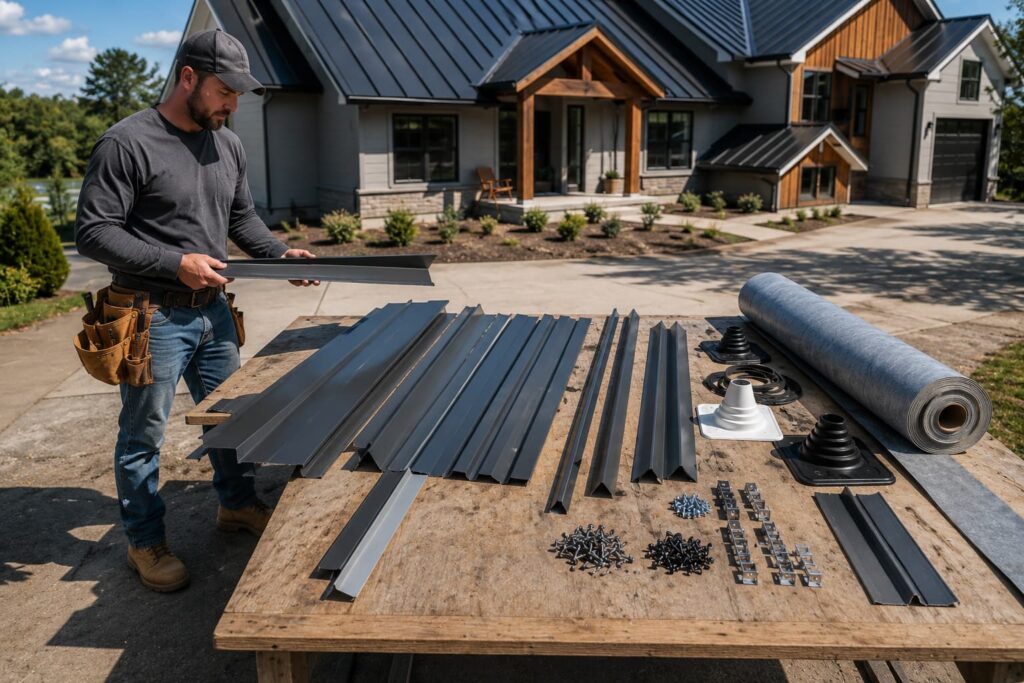
A complete metal roof estimate covers more than just the panels. The table below shows every line item a full estimate should include, which you can use as a reference template when comparing supplier quotes or building your own material list.
| Line Item | Unit | Notes |
| Metal panels | Squares or linear ft | Based on net coverage width, not gross |
| Ridge cap | Linear ft | Length of every ridge line |
| Rake trim | Linear ft | Both rake edges on each gable end |
| Eave trim or drip edge | Linear ft | Full perimeter at eave |
| Valley flashing | Linear ft | Each valley, both sides |
| Pipe boot flashings | Each | One per roof penetration |
| Closure strips (foam) | Linear ft | Open-rib panels at eave and ridge |
| Fasteners and screws | Box | Approx. 80 screws per square for exposed fastener |
| Underlayment | Square | Match to panel type and pitch |
| Sealant tape | Roll | At all laps and penetrations |
| Labor | Per square | $300 to $800 per square, varies by region |
Trim and accessory items typically add 10 to 15 percent to the panel-only material cost and are commonly left off initial supplier quotes. Requesting a line-item breakdown from every supplier before comparing prices ensures each quote covers the same scope.
How Much Does a Metal Roof Cost in 2026?
| Material | Life Expectancy | Material Cost per Square | Installed Cost per Square |
| Galvalume steel standing seam | 40 to 60 years | $300 to $700 | $600 to $1,400 |
| Aluminum standing seam | 40 to 70 years | $400 to $900 | $700 to $1,600 |
| Corrugated steel (exposed fastener) | 25 to 40 years | $150 to $350 | $300 to $700 |
| Copper standing seam | 70 to 100+ years | $1,500 to $3,000 | $2,500 to $5,000 |
| Stone-coated steel shingle | 40 to 70 years | $350 to $700 | $600 to $1,200 |
| Metal shake or shingle panel | 30 to 50 years | $400 to $900 | $700 to $1,500 |
| R-panel or corrugated (pole barn) | 25 to 40 years | $100 to $250 | $200 to $500 |
These figures represent typical 2026 market ranges as commonly reported by US metal roofing suppliers and contractors for standard single-story residential and agricultural reroofs with straightforward access. Material prices fluctuate with steel and aluminum commodity markets and should be confirmed with local suppliers before finalizing a budget.
The total installed cost for a metal roof on a typical 2,000 square foot home in 2026 ranges from roughly $12,000 for corrugated steel to more than $60,000 for copper, depending on panel type, pitch complexity, and regional labor rates.
What Is a Roofing Square and How Many Do I Need?
A roofing square is defined as 100 square feet of roof surface area, and it is the standard unit used by contractors and material suppliers across the United States for pricing and ordering metal panels. Divide your total calculated roof area including waste by 100 to find your square count. A 2,000 square foot base footprint at a 6:12 pitch with 10 percent waste requires approximately 24.6 roofing squares of metal panel material.
How Do I Calculate How Many Metal Panels I Need?
The number of panels depends on the net coverage width of the product you are installing. Divide your total roof area by the net coverage width, not the labeled or gross panel width.
For a standing seam panel with 16-inch net coverage width and a 10-foot panel length, each panel covers approximately 13.3 square feet. A 1,900 square foot order divided by 13.3 equals approximately 143 panels before accounting for directional cuts at the ridge or rake.
For corrugated panels with 26-inch effective net coverage and 10-foot length, each panel covers about 21.7 square feet. The same 1,900 square foot job would need approximately 88 panels.
Always confirm the exact net coverage width with your supplier, since some panels list gross width rather than net coverage width after overlap. Ordering on gross width rather than net width is one of the most preventable causes of running short on metal panels mid-installation.
What Underlayment Does a Metal Roof Require?
Metal roofing requires an underlayment between the panels and the roof deck in most applications, and the correct type depends on the panel system and slope. For standing seam systems on slopes of 3:12 and above, self-adhering polymer-modified bitumen underlayment or synthetic underlayment meeting ASTM D226 Type II is typically specified. On low-slope standing seam applications below 3:12, most manufacturers require a fully adhered self-adhering product across the entire deck under IRC R905.10.3. For exposed fastener corrugated panels on agricultural or pole barn structures, 30-pound felt is commonly used, though synthetic underlayment lasts longer and does not absorb moisture. Always confirm the underlayment specification in your panel manufacturer's technical data sheet, since some premium coating systems require specific underlayment products to maintain the warranty.
What Waste Allowance Should I Use for Metal Roofing?
A 10 percent waste allowance is standard for simple gable metal roofs with minimal penetrations. Hip roofs, roofs with multiple valleys, skylights, or chimneys typically require 15 percent waste because each feature requires additional cuts that reduce the usable length of every panel running toward it. A hip roof with four sloped sides should use a 15 percent waste factor at minimum to avoid running short mid-installation.
What Are the Minimum Pitch Requirements for Metal Roofing?
The International Residential Code sets different minimum pitch requirements for different metal panel types. Standing seam panels can be installed at pitches as low as a quarter inch per foot under IRC R905.10.2. Corrugated and exposed fastener metal panels require a minimum 3:12 pitch under most manufacturer guidelines and local IRC interpretations. Metal shingles require a minimum of 3:12 under IRC R905.11. Local amendments may impose stricter requirements, so always confirm with your local building department before ordering material for a low-slope application.
What Should I Do With My Calculator Result?
If you are comparing contractor quotes, give every contractor the same square footage and panel type so each bid reflects an identical scope. A quote that returns a significantly different square count than your calculator result should prompt a direct question about how the contractor measured and what waste factor they used.
If you are ordering material yourself, take your square count to your supplier and confirm the panel coverage width, net versus gross dimensions, and whether the quoted price includes trim pieces such as ridge caps, rake trim, eave trim, and closure strips. Use the estimate template table above as a checklist to confirm every line item is included before comparing quotes from different suppliers.
If your result calls for more than 20 squares on a steep pitch, request a written fall protection plan from your installer. OSHA 29 CFR 1926.502 requires personal fall arrest systems on residential roofs at pitches of 6:12 and above, and metal panels are significantly more slippery than asphalt shingles during installation.
If you are pulling a permit, most jurisdictions require one for a full metal roof replacement. The application typically asks for roof area in square feet or squares, which your calculator result provides directly.
This calculator covers metal roofing panels only. Metal wall panels and metal siding use different coverage rates, overlap requirements, and panel profiles. If you are estimating metal siding, the measurements and ordering process differ from what is described here.
What Are Common Mistakes When Calculating Metal Roof Material?
Using interior square footage instead of the exterior footprint is the most frequent error. A 2,000 square foot home often sits on a 2,200 to 2,400 square foot exterior footprint once wall thickness and attached garage are included.
Forgetting the eave overhang causes consistent short ordering. On a 40 by 30 foot house with 12-inch overhangs, the real dimensions are 42 by 32 feet, adding 124 square feet before the pitch correction is even applied.
Using gross panel width instead of net coverage width overstates how much area each panel covers. Corrugated panels listed as 36 inches wide often provide only 32 to 33 inches of net coverage after the overlap.
Skipping trim and accessory quantities leads to unexpected reorders. Ridge caps, rake trim, drip edge, and closure strips are separate line items not included in a standard panel order and typically add 10 to 15 percent to the panel-only cost.
Using a 10 percent waste factor on a hip roof leaves most projects short. Hip roofs need 15 percent minimum because every panel on every slope gets an angled cut at the hip line.
Ordering panel length based on horizontal run instead of slope distance is a pole barn and corrugated panel specific mistake. The slope length is always longer than the horizontal run, and panels ordered too short cannot be extended after delivery.
Assuming all standing seam systems share the same minimum pitch causes installation failures. Some concealed fastener systems are engineered for pitches as low as 1:12 with special underlayment, while others require 2:12 or 3:12 per the manufacturer's technical data sheet.
Frequently Asked Questions
What is a metal roof calculator?
A metal roof calculator is a free tool that converts your building dimensions and roof pitch into total material area in square feet, roofing squares, panel count, and an estimated cost range. It applies a pitch correction factor automatically so the output matches what suppliers and contractors use for pricing.
How do I calculate the square footage of a metal roof?
Multiply your exterior building footprint including eave overhangs by the pitch correction factor for your roof slope, then add a 10 to 15 percent waste allowance. For a 40 by 30 foot house with a 6:12 pitch and 12-inch overhangs, the calculation is 42 by 32 equals 1,344 square feet, multiplied by 1.118, which gives approximately 1,502 square feet of actual roof surface before waste.
What is the cost of a metal roof per square in 2026?
Metal roof installed cost per square in 2026 ranges from approximately $300 for corrugated steel to more than $2,500 for copper, as commonly reported by US roofing contractors. Standing seam steel or Galvalume, the most popular residential choice, typically costs $600 to $1,400 per installed square.
What is the minimum pitch for a metal roof?
Standing seam metal panels can be installed at pitches as low as a quarter inch per foot under IRC R905.10.2. Corrugated and exposed fastener panels generally require a minimum 3:12 pitch per most manufacturer guidelines and IRC interpretations.
How long does a metal roof last?
A Galvalume or painted steel standing seam roof typically lasts 40 to 60 years. Aluminum standing seam systems last 40 to 70 years. Copper roofs regularly exceed 100 years with minimal maintenance, as widely documented in architectural preservation records.
Is a metal roof worth it compared to asphalt shingles?
A metal roof costs three to five times more than asphalt shingles upfront but lasts two to four times longer, making the lifetime cost per year comparable or lower in most cases. Metal roofing also performs better in high-wind, hail, and wildfire risk areas, which can reduce insurance premiums in some regions.
I have a 1,500 square foot house with a 6:12 pitch. How many squares of standing seam do I need?
A 1,500 square foot base footprint at a 6:12 pitch uses a correction factor of 1.118, producing approximately 1,677 square feet of actual roof surface. Adding 10 percent for waste brings the order total to about 1,845 square feet, or 19 roofing squares, assuming eave overhangs are already included in the footprint figure.
How do I calculate metal roofing for a hip roof?
Divide the hip roof into its individual triangular and trapezoidal sections, calculate each section's horizontal footprint area separately, sum all sections, then multiply by the pitch correction factor and add 15 percent for waste. Do not use a single length-by-width footprint for a hip roof, since that method understates the total area and applies the pitch factor incorrectly to sections that drain in different directions.
Can I install metal roofing over existing shingles?
Most local codes allow one layer of metal over existing asphalt shingles, but this varies by jurisdiction and should be confirmed with your building department before ordering material. Installing over existing shingles affects trim fitment at the eave and ridge and should be discussed with your installer before finalizing the panel length order.
What is the difference between standing seam and exposed fastener metal roofing?
Standing seam panels connect at raised seams with hidden clips, leaving no exposed screws on the roof surface and eliminating the main long-term leak point in metal roofing. Exposed fastener panels, including corrugated and R-panel systems, cost less to install but require periodic inspection and replacement of the neoprene washers under each fastener as they age.
How This Calculator Was Built
Our research team built this calculator using pitch correction formulas consistent with NRCA estimating references and IRC Section R905 material requirements. Panel coverage rates and minimum pitch thresholds are drawn from manufacturer technical data sheets and published product specifications. Underlayment requirements reference IRC R905.10.3 and ASTM D226 Type II specifications. Waste factor guidance follows general industry practice for metal roofing installation, with higher factors applied for hip and complex roofs based on standard field practice. Cost figures reflect typical 2026 US market conditions as commonly reported by metal roofing suppliers and contractors, and should be treated as planning benchmarks rather than formal quotes. These calculators and guides are built for accurate material planning. For structural decisions, permit submissions, or installations on low-slope or complex roofs, always verify your results with a licensed contractor or your local building department.