Enter rise and run values above to see the roof pitch, angle, and rafter length visually.
Roof pitch calculators take your roof's run and rise measurements and convert them to a pitch ratio, an angle expressed in degrees, or a slope percentage. They also calculate the rafter length. The calculator will handle the rest. You don't need to calculate four different formulas. This page explains what each result means, and how you can use it to frame a roof, order materials, or discuss specs with a builder.
What Is a Roof Pitch Calculator?
Roof pitch is the steepness or slope of a roof. It's measured in inches for every 12-inch horizontal span. For example, a 6:12 pitch rises six inches every 12 inches. Roof slope is described this way everywhere in America, regardless of whether it's a home, a garage, or a backyard shed.
Pitch and slope are often confused, but the difference is really only academic. Slope equals rise divided by run. Pitch, technically speaking, is rise divided by the full span, which is just the run doubled. Roofers, contractors, and suppliers use both terms to describe the same thing on the jobsite. This guide follows that convention.
A 4:12 pitch is about 18.4°. A pitch of 6:12 is roughly 26.6°. These two pitches are enough to cover the majority of homes in the US. The vast majority of roofs fall between 4:12 and 9:12.
How to Calculate Roof Pitch Using a Roof Pitch Calculator
You can calculate the X:12 pitch by dividing the rise by the run. Then multiply the result by 12. If your roof rises 5 inches over a 12-inch run, then you have a 5:12 pitch. This is the fastest manual method, and the calculator performs the same calculation automatically after you enter the rise and run values..
The formula is written below:
Pitch ratio = (Rise ÷ Run) × 12
Skip the step of multiplying by 12 if you want a percentage instead. Divide the rise by the run, then multiply by 100. A roof that rises 6 inches for every 12 inches of run has a slope of 50 percent.
Step
Action
Example
1
Measure rise in inches
5 inches
2
Measure run in inches
12 inches
3
Divide rise by run
5 ÷ 12 = 0.417
4
Multiply by 12 for the ratio
5:12
5
Multiply by 100 for the percent
41.7%
How do I measure the rise and run on my own roof?
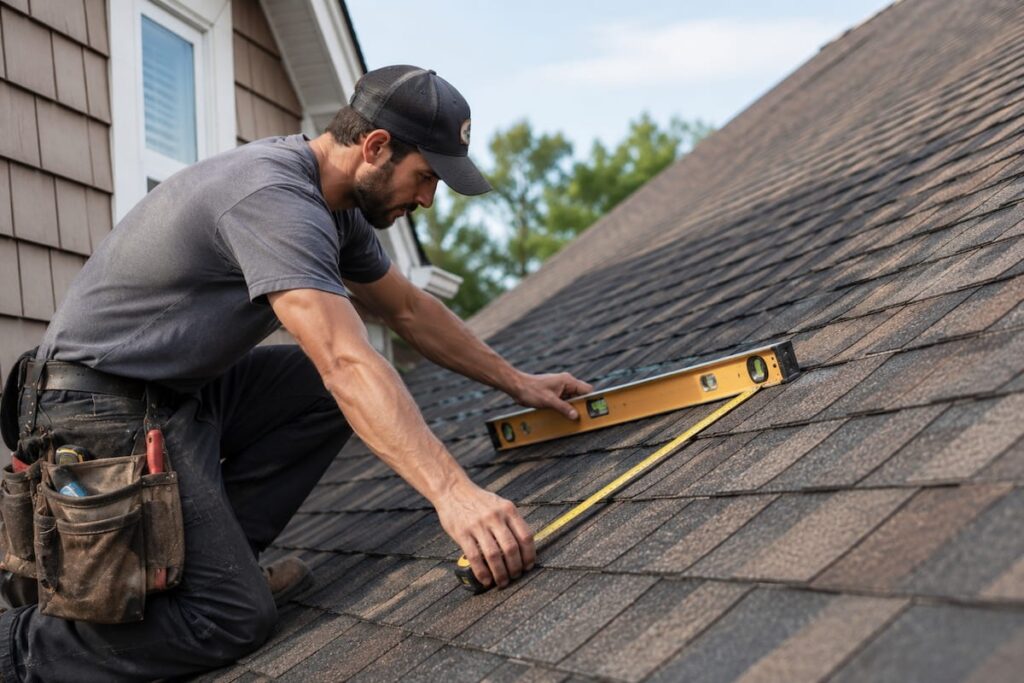
This measurement can be taken from the roof or the attic. You can choose whichever is more convenient or safer.
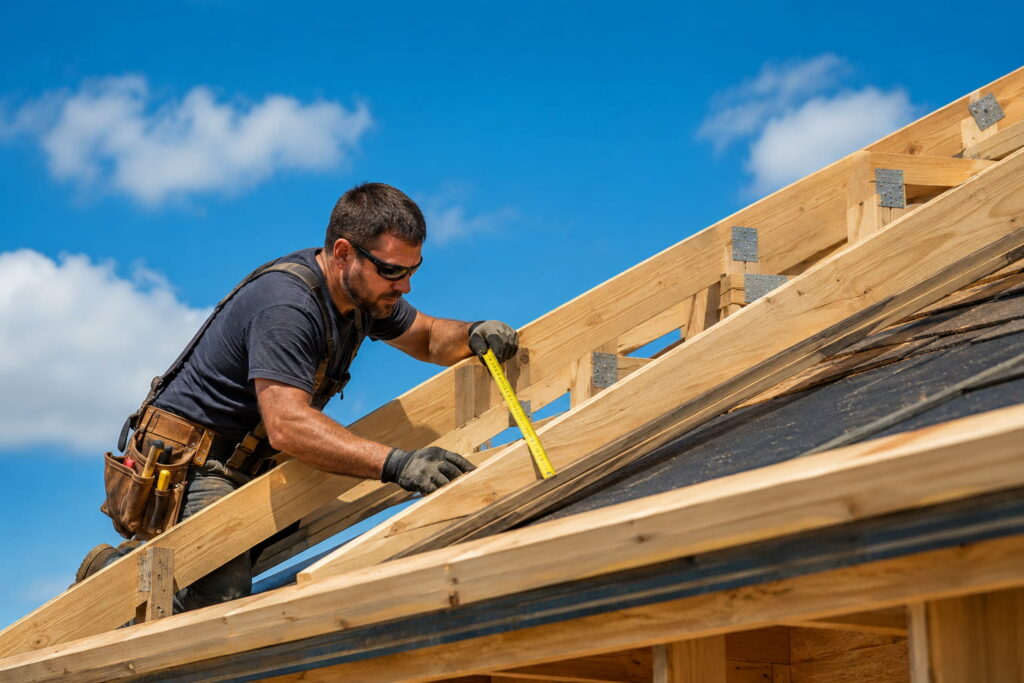
Hold the level against the underside of a rafter and stretch it out 12 inches exactly from a fixed point. Measure straight down from the 12-inch mark to the top of a rafter. This distance is the rise.
From the roof surface, lay the level flush against the roof, mark off 12 inches, then measure straight down to the surface beneath that mark. The same result will be obtained by measuring the rise per 12 inches. If you don't feel comfortable getting on top of the roof, you can use a smartphone app to measure the pitch from the ground.
For the most accurate roof pitch calculator result, measure both rise and run in the same unit before entering the numbers.
How do I convert roof pitch to degrees?
You can find your angle by dividing the rise by the run and taking the arctangent of that number. This is arctan(6/12) for a pitch of 6:12. It comes out at 26.6 degrees. It's a common conversion because structural engineers and architects tend to think of pitch in degrees. At the same time, people who are actually cutting the lumber or ordering the shingles use the X:12 ratio.
Pitch
Angle
Slope %
1:12
4.8°
8.3%
2:12
9.5°
16.7%
3:12
14.0°
25%
4:12
18.4°
33.3%
5:12
22.6°
41.7%
6:12
26.6°
50%
7:12
30.3°
58.3%
8:12
33.7°
66.7%
9:12
36.9°
75%
10:12
39.8°
83.3%
12:12
45.0°
100%
The pitch of a 12:12 roof is 45 degrees. This is where the rise and run are equal. It is rare to find anything steeper than 12:12, except for A-frame cabins or decorative rooflines.
How do I calculate the length of a rafter from its pitch?
The Pythagorean theorem gives us the rafter length, as rise, run, and the rafter form a right-angled triangle. Rafter length is equal to the square root of rise squared plus run squared. For a 6:12 pitch, this works out to a multiplier of 1.118. So a 10-foot run gives you an approximate rafter length of 11.18 feet.
It's important to know that the number you get from this calculator is the length of the line, measured along the top of the rafter from the centre of the ridge outwards to the wall line. You're not done yet. Before you touch the saw, there are two more adjustments to make
Before estimating roofing materials, use our Roof Area Calculator to calculate the total roof surface area and roofing squares more accurately.
Add the overhang first. Since the overhang extends beyond the wall line, it is not included in the basic run measurement. It must be added before applying the pitch multiplier. Then subtract the thickness of the ridge beam. The rafter meets the side of the ridge board, not its centre. Therefore, subtract half the beam's thickness from the top. For a 1.5-inch ridge board, subtract 0.75 inches.
Find the pitch, angle, and rafter length using this example.
Let's do a complete calculation from start to finish using real numbers.
Imagine that a roof rises 5 inches over a 12-inch run.
Step 1: Pitch ratio. Five divided by 12, times 12, gives you 5:12.
Step 2: Angle. Arctan of 5 divided by 12 comes out to about 22.6 degrees.
Step 3: Slope percentage. Five divided by 12, times 100, equals 41.7 percent.
Step 4: Pitch multiplier. Square root of (5 squared plus 12 squared), divided by 12, equals approximately 1.083.
Step 5: Apply the multiplier to your actual run. With a 10-foot total run, that's 10 times 1.083, or 10.83 feet of rafter line length.
Step 6: Add the overhang. Say it's 1.5 feet. Ten feet plus 1.5 feet is 11.5 feet, times 1.083, which gives you 12.45 feet.
Step 7: Subtract the ridge beam. Half the thickness of a 1.5-inch beam is 0.75 inches, or 0.0625 feet. This brings the final rafter to approximately 12.39 feet.
What Roof Pitch is considered walkable?
In general, anything 6:12 or below is considered walkable. Most homeowners and contractors will use this line to decide whether or not a roof jack or harness is worth it.
According to OSHA roof safety guidelines, workers should use proper fall protection systems when working on steep-slope roofs or at heights where fall hazards exist.
Pitch
Walkability
Up to 6:12 (26.6°)
No special precautions are needed to walk on the surface
7:12 (30.3°)
Manageable but with caution
8:12 to 10:12 (33.7° to 39.8°)
Equipment recommended for walkable but potentially dangerous terrain
Above 10:12
Not possible to walk without scaffolding and a harness
Although a 7:12 roof may be walkable for experienced roofing professionals, OSHA and other safety guidelines recommend using appropriate fall protection whenever there is a risk of falling. Weather conditions, roof height, and roofing material should always be considered before walking on any roof., but only for experienced climbers in dry weather. Safety guidelines recommend a harness and anchors once you pass 6:12. In wet or icy conditions, even that pitch is more dangerous.
What is the minimum roof pitch for snow to slide off?
The most common figure for the minimum roof pitch required to shed snow is between 6:12 and 7:12, or approximately 30 degrees. This is not a rule that must be followed. Roofs with a slope as low as 10 degrees can shed snow on their own, depending on the texture of the roofing surface and the amount of sun the roof receives.
It's better to go steeper than the minimum slope if you live in an area that receives a lot of snow. This will reduce the structural load on the house and the risk of ice damming at the eaves, because less snow will pile up.
What roof pitch works with my roofing material?
Each roofing material has its own minimum pitch. This is because water needs to drain before it can get underneath. Asphalt shingles can be installed as low as 2:12, but only if a waterproof underlayment is added. Standard installation instructions assume that the slope will be steeper for ordinary use. If you are estimating shingles after checking pitch, use our Shingle Calculator to calculate bundles and waste more accurately.
Material
Minimum Pitch
Standing seam metal
1:12
TPO or EPDM membrane
1:12 (often used below 2:12)
Corrugated metal
3:12
Asphalt shingles
2:12 with additional underlayment
Wood shake
4:12
Clay or concrete tile
2.5:12 (double underlayment required from 2.5:12 to 4:12)
Slate
4:12
Can you shingle roofs with a 3:12 slope? Yes. A 3:12 pitch is above the minimum standard for asphalt shingles, and most manufacturers won't require additional underlayment at that slope. It's still worth checking the packaging, as brand requirements can vary.
What should I do with my calculator results?
Check your pitch for material compatibility first, as it will determine your options. If your number lands right at a material's minimum, lean toward treating it as the steeper interpretation rather than rounding down. Being a little short on slope causes a lot more headaches than being a little over.
Budget extra time and labour before calling contractors if your pitch is above 7:12. When harnesses and roof jacks are involved, most crews will charge more, and the work progresses more slowly on a steep slope. When ordering rafters, don't forget to add the overhang and subtract the ridge beam thickness. The calculator gives you a number that represents the line length, not your final cut.
What are the common mistakes people make when calculating roof pitch?
The big one is measuring the full roof span instead of the run. This doubles the rise, making your pitch appear twice as steep. The run is half the roof span, measured from the centre ridge to the outer wall. It's never the entire width.
People also make mistakes when they mix up units in the middle of a calculation, such as measuring rise in inches but run in feet without first converting. The calculator's rafter number is often misinterpreted as the final cut length, when it's actually the line length before overhang and ridge beam adjustments. Another mistake to watch out for is assuming that a single pitch applies to the entire roof. Porches, dormers, or additions are often at a different angle from the main structure and require their own separate measurement.
FAQs
What is roof pitch?
Roof pitch measures the steepness of a roof in terms of inches per 12 inches of run. A 6:12 roof pitch rises 6 inches over the same 12-inch horizontal run, which works out to about 26.6 degrees.
How can I calculate the pitch of my roof without climbing up on it?
No roof access is required to measure the rise and run from your attic. All you need is a level held against a rafter. Hold the level at exactly 12 inches, then measure straight down to the rafter to find the rise.
What is a roof pitch of 4:12?
A 4:12 pitch is a ratio of 4 inches of rise per 12 inches of run, or about 18.4 degrees. This is one of the most popular pitches on US homes, and it works well with almost all standard roofing materials.
Does there exist a standard pitch for roofs?
There is no standard pitch. Your local building codes, climate, and architectural style will determine the right pitch. The average US roof pitch falls between 4:12 and 9:12
What is the maximum roof pitch that can be walked on without a harness?
In general, walking at 6:12 or below without any special gear is okay. Most safety guidelines recommend a harness and anchors once you reach 7:12, especially if conditions are wet.
What is the minimum pitch of a roof to allow snow to fall naturally?
The minimum slope for snow to shed naturally is usually between 6:12 and 7:12, or approximately 30 degrees. If there is heavy snow in the area, going steeper reduces structural load and the risk of ice dams.
What is the effect of roof pitch on installation costs?
As soon as you go above 7:12, labour costs typically increase, because crews require harnesses, roof jacks, and extra time to work safely. As of 2026, contractors commonly report steep-slope surcharges as a percentage of the base labour rate rather than as a flat dollar amount, since the surcharge depends on the region and the roof's complexity. For a full estimate, use our Roof Cost Calculator after checking the pitch.
What is the roof pitch multiplier?
This is the number you multiply a flat footprint by to get the sloped roof's actual surface area. The multiplier for a 6:12 pitch is 1.118. A 1,000-square-foot footprint actually has about 1,118 square feet of roof surface to cover.
Can I use the calculator if my roof has more than one pitch?
Yes, but measure and calculate each roof section separately rather than using a single number for the entire roof. The pitch of a porch is often different from the pitch of the main house. Use the calculator for each section separately and then add the totals.
Does a 9:12 roof pitch make it too steep for standard residential construction?
Not really. Although it's steep at about 36.9 degrees, this is still within the range of normal residential construction. It costs more to frame and roof than a 6:12 pitch, but it's common on Victorian, Craftsman, and steep-gable homes.
Sources and Calculation Methodology
This guide uses the same trigonometry as framing squares, speed squares, and other job site math to calculate every pitch, angle, and rafter length. Minimum pitch and walkability guidelines are based on what is commonly found in manufacturer installation instructions and framing industry references. Cost figures and steep-slope surcharges should be treated as general patterns, not fixed numbers, since real contractor prices vary by region. These calculators are not meant to replace professional judgement, but to assist in planning. If you have any questions about permits or structural issues that may affect your safety, consult a local building department or a licensed contractor. You can also check the International Residential Code to see what minimum slope requirements apply in your area.