Roof Area Visual Diagram
Enter your dimensions and pitch above, then click Calculate to see how slope increases the actual shingle surface area above the flat footprint.
The free shingle calculator takes your roof dimensions and pitch, then returns the number of bundles needed, roofing squares, and an estimated material cost for your project. Enter your building length, width, roof slope, and shingle type and the calculator does the rest. It works on any phone or tablet without downloading an app, so there is no need to search for a separate shingle calculator app or visit a retailer site. The figures it produces match what roofing suppliers and contractors use when quoting a job, giving you an independent number before you contact anyone.
What Is a Shingle Calculator and What Does It Measure?
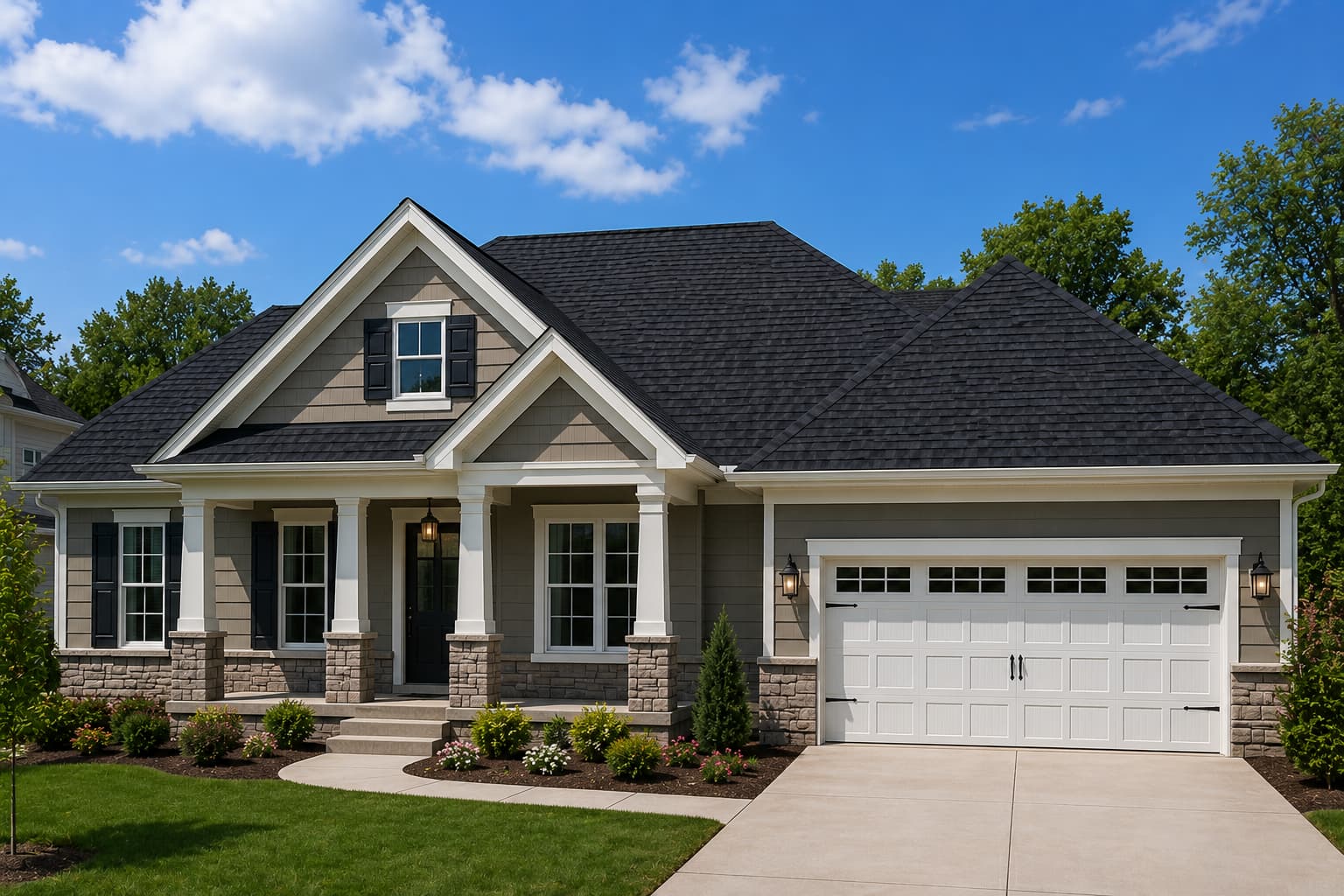
A shingle calculator is defined as a tool that converts your roof's base dimensions and slope into the number of shingle bundles, roofing squares, and estimated material cost needed to complete a residential roofing project. The calculator applies a pitch correction factor to your flat footprint to find the true sloped surface area, then divides that figure by the coverage rate of your chosen shingle type to produce a bundle count. This matters because a sloped roof always covers more surface than the flat footprint beneath it, and ordering based on floor plan square footage alone is the most common reason homeowners run short on shingles mid-project.
This calculator is not tied to any particular brand or retailer. It works across all standard shingle types and gives you a number you can bring to any supplier or contractor for comparison If you do not already know your roof area, use our Roof Area Calculator to calculate the total roof surface before estimating shingle bundles and roofing squares Always verify the bundle coverage printed on your chosen shingle product before placing your final order, as coverage can vary slightly between manufacturers and product lines.
How Does the Shingle Calculator Work?
The calculator multiplies the exterior footprint of your building by a pitch correction factor derived from the Pythagorean theorem, treating the roof slope as the hypotenuse of a right triangle formed by the rise and the horizontal run. That corrected area is divided by the net coverage rate of your specific shingle product to produce a bundle count. The formula is: Actual Roof Area = Base Footprint Area multiplied by the square root of one plus the result of dividing the roof rise by 12, then squaring that result. This method is consistent with NRCA estimating guidance and aligns with material application requirements in IRC Section R905.2.
What Inputs Does the Shingle Calculator Need?
Building length and width are the exterior dimensions of your structure at the base, measured in feet. Use outer wall measurements, not interior living space, since the roof overhangs the walls on all sides.
Eave overhang is the distance the roof extends past the exterior wall on each side. A standard residential overhang runs 12 to 18 inches. Omitting this input causes a consistent undercount that adds up quickly on larger roofs.
Roof pitch is written as rise over run, such as 4:12 or 6:12. A 6:12 pitch means the roof rises 6 inches for every 12 inches of horizontal run. If you do not know your pitch, our Roof Pitch Calculator can help you measure it from the attic with a level and a tape measure.
Shingle type determines how many square feet each bundle covers. Three-tab, architectural, and designer shingles all have different bundle coverage rates. Always confirm the net coverage figure on your specific product's packaging before finalizing your order.
Waste factor adds a percentage on top of your base area to cover cuts around ridges, hips, valleys, dormers, and penetrations. The Asphalt Roofing Manufacturers Association recommends a minimum 15 percent waste allowance for most residential reroofing projects.
What Are the Different Types of Asphalt Shingles and How Do They Affect Bundle Count?
| Shingle Type | Net Coverage per Bundle | Bundles per Square | Life Expectancy | Material Cost per Square (2026) |
| 3-tab asphalt | 33.3 sq ft | 3 | 15 to 25 years | $80 to $150 |
| Architectural (laminate) | 32 to 33 sq ft | 3 | 25 to 30 years | $150 to $250 |
| Impact-resistant Class 4 | 32 to 33 sq ft | 3 | 30 to 40 years | $250 to $450 |
| Designer / premium | 20 to 25 sq ft | 4 to 5 | 30 to 50 years | $300 to $600 |
| Luxury (slate-look) | 20 to 22 sq ft | 4 to 5 | 30 to 50 years | $400 to $700 |
Architectural shingles, also called laminate or dimensional shingles, are the most commonly installed type in the United States as of 2026 because they offer better wind and impact resistance than three-tab at a modest price premium. The architectural shingle calculator function built into this tool uses 33 square feet per bundle as a default, but always confirm the exact net coverage on your product's packaging since it varies by manufacturer and product line.
GAF is one of the largest shingle manufacturers in the United States and offers its own brand-specific estimating tools. This calculator produces the same square footage and bundle count calculation but works across all brands and shingle types, so the result can be taken to any supplier regardless of brand.
How Do I Calculate How Many Shingles I Need in Square Feet Step by Step?
This example uses a gable roof on a house that is 40 feet long and 28 feet wide, with a 1-foot eave overhang on all four sides and a 6:12 pitch. The homeowner is using architectural shingles with a net coverage of 33 square feet per bundle.
Step 1: Adjust for the overhang. Add 1 foot to each end of both dimensions. Adjusted length is 42 feet, adjusted width is 30 feet. Base footprint is 42 multiplied by 30, which equals 1,260 square feet.
Step 2: Apply the pitch correction factor. A 6:12 pitch has a correction factor of 1.118. Multiply 1,260 by 1.118, which equals approximately 1,409 square feet of actual sloped roof surface.
Step 3: Add the waste allowance. Adding 15 percent: 1,409 multiplied by 1.15 equals approximately 1,620 square feet total to order.
Step 4: Convert to roofing squares. Divide by 100: 1,620 divided by 100 equals 16.2 squares. Round up to 17 squares for ordering.
Step 5: Convert to bundles. Multiply squares by 3 for architectural shingles: 17 multiplied by 3 equals 51 bundles.
A 1,260 square foot base footprint at a 6:12 pitch with 15 percent waste requires approximately 51 bundles of architectural shingles, or 17 roofing squares.
Pitch Correction Factor Table for Shingle Estimation
| Pitch | Angle | Correction Factor | Extra Area vs Flat Footprint |
| 2:12 | 9.5° | 1.014 | +1.4% |
| 3:12 | 14.0° | 1.031 | +3.1% |
| 4:12 | 18.4° | 1.054 | +5.4% |
| 5:12 | 22.6° | 1.083 | +8.3% |
| 6:12 | 26.6° | 1.118 | +11.8% |
| 7:12 | 30.3° | 1.158 | +15.8% |
| 8:12 | 33.7° | 1.202 | +20.2% |
| 9:12 | 36.9° | 1.250 | +25.0% |
| 10:12 | 39.8° | 1.302 | +30.2% |
| 12:12 | 45.0° | 1.414 | +41.4% |
A 12:12 pitch roof requires 41.4 percent more shingle material than the same building's flat footprint, which is why steep roofs cost significantly more to shingle than shallow ones even when the house footprint is identical.
What Is a Roofing Square and How Many Do I Need?
A roofing square is defined as exactly 100 square feet of roof surface area, and it is the standard unit that contractors and roofing suppliers across the United States use for pricing and ordering shingles. To find your square count, divide your total calculated roof area including waste by 100, then round up to the nearest whole number before ordering. Three bundles of standard three-tab or architectural shingles cover one roofing square, while premium and designer shingles typically require four to five bundles per square.
How Do I Use a Shingle Calculator for a Hip Roof?
A hip roof has four sloped sides instead of two, which means more cuts at the hip lines and a higher waste factor than a standard gable. The base calculation uses the same pitch correction formula: multiply your exterior building footprint by the correction factor for your slope. However, a hip roof should use a 15 to 20 percent waste factor rather than 10 percent, because every shingle course running toward a hip line must be cut at an angle and the offcut cannot be reused the way a straight ridge cut can on a gable.
For a hip roof on a building that is 50 feet long and 36 feet wide with a uniform 6:12 pitch: the footprint is 1,800 square feet, multiplied by 1.118 gives 2,012 square feet of sloped surface. Adding 18 percent for waste gives 2,374 square feet, or approximately 24 roofing squares, which equals 72 bundles of standard architectural shingles.
Hip roofs also have longer combined hip and ridge lines than gable roofs of the same footprint, which means a larger separate order of ridge cap and hip cap shingles. Measure every hip line and ridge line, add the lengths together, then divide by 35 to find the additional bundles of hip and ridge cap needed.
How Do I Calculate Architectural Shingles Specifically?
Architectural shingles, also called dimensional or laminate shingles, use the same square footage calculation as any other shingle type but require confirming the exact net coverage per bundle from the manufacturer's packaging before ordering. Most architectural shingle products cover 32 to 33 square feet per bundle, making three bundles equal to one roofing square, but some heavy-weight or premium architectural lines cover as little as 25 square feet per bundle and require closer to four bundles per square.
The architectural shingle calculator function in this tool defaults to 33 square feet per bundle. If your specific product lists a different net coverage figure, enter that number in the custom coverage field to get an accurate bundle count for your brand and product line. This applies to GAF Timberline, Owens Corning Duration, CertainTeed Landmark, and all other major architectural shingle lines that may vary slightly in their per-bundle coverage.
What Is the Minimum Roof Pitch for Asphalt Shingles?
The International Residential Code Section R905.2.2 sets the minimum pitch for asphalt shingles at 2:12 with double underlayment, or 4:12 for a standard single-layer underlayment installation. A roof pitched below 2:12 cannot use standard asphalt shingles under the IRC regardless of underlayment type, and alternative low-slope materials such as modified bitumen or TPO membrane must be used instead. Local building codes may impose stricter minimums, so confirm with your building department before ordering shingles for any roof below 4:12.
How Much Do Shingles Cost in 2026?
| Shingle Type | Material Cost per Square | Installed Cost per Square | Life Expectancy |
| 3-tab asphalt | $80 to $150 | $150 to $250 | 15 to 25 years |
| Architectural / laminate | $150 to $250 | $250 to $400 | 25 to 30 years |
| Impact-resistant Class 4 | $250 to $450 | $400 to $600 | 30 to 40 years |
| Designer / premium | $300 to $600 | $500 to $800 | 30 to 50 years |
| Luxury (slate-look) | $400 to $700 | $600 to $1,000 | 30 to 50 years |
These figures reflect typical 2026 market ranges as commonly reported by US roofing suppliers and contractors for standard single-story residential reroofs with straightforward access. Material costs move with oil and asphalt commodity markets and should be confirmed with your local supplier before finalizing a budget.
The total installed cost to reshingle a typical 2,000 square foot home in 2026 ranges from approximately $5,000 for three-tab shingles to more than $20,000 for luxury designer products, depending on shingle type, pitch complexity, and regional labor rates.
What Underlayment Do Asphalt Shingles Require?
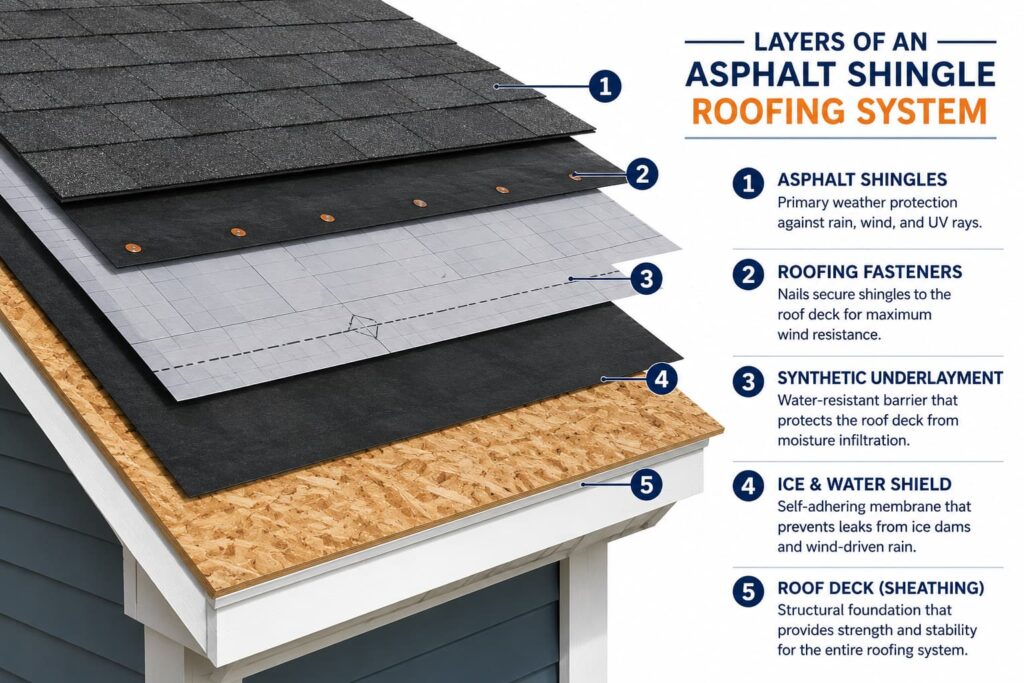
Asphalt shingles require an underlayment layer between the shingles and the roof deck on all standard installations. For roofs at 4:12 and above, a single layer of synthetic underlayment or ASTM D226 Type I felt is the standard requirement under IRC R905.2.7. Pitches between 2:12 and 4:12 require double underlayment. In climate zones where the outside design temperature reaches 25 degrees Fahrenheit or below, ice and water shield must be installed along the eaves and in all roof valleys under IRC R905.2.7.1, regardless of pitch. Underlayment is a separate material from shingles and should be included as its own line item in any complete material estimate.
What Should I Do With My Shingle Calculator Result?
If you are ordering materials yourself, take your bundle count to the supplier and confirm the exact net coverage printed on the packaging of your chosen product before finalizing the order. Add ridge cap and hip cap shingles as a separate line item, since these are sold by the bundle and cover approximately 35 linear feet per bundle. Measure the total length of all ridge and hip lines on your roof, divide by 35, and round up to find how many additional bundles to add.
If you are comparing contractor quotes, give every contractor the same square footage figure so each bid reflects an identical scope of work. A contractor whose square count differs significantly from your calculator result should explain their measurement method and waste factor before you accept or reject their number.
If your project involves 25 or more squares on a pitch of 6:12 or steeper, confirm with your installer that they use proper fall protection. OSHA 29 CFR 1926.502 requires personal fall arrest systems for workers on residential roofs at slopes of 6:12 and above.
If you are pulling a permit, most US jurisdictions require one for a full reshingle. The permit application typically asks for the roof area in square feet or squares, which your calculator result provides directly.
Homeowners who want to cross-check their result can use a Home Depot roofing calculator or a GAF shingle calculator as a secondary reference, but confirm that both use the same base footprint and waste factor to ensure the comparison is valid.
What Are Common Mistakes When Using a Shingle Calculator?
Using interior square footage instead of the exterior footprint is the most frequent ordering error. A home with 2,000 square feet of interior living space often sits on a 2,200 to 2,400 square foot exterior footprint once wall thickness and an attached garage are accounted for.
Skipping the eave overhang input causes consistent undercounts. On a 40 by 30 foot house with 12-inch overhangs on all four sides, the real dimensions are 42 by 32 feet, adding 124 square feet before the pitch correction is even applied.
Using 10 percent waste on a hip or complex roof leaves most projects short. Hip roofs, roofs with multiple valleys, and roofs with dormers or skylights need 15 to 20 percent waste because offcuts from angled cuts at hip lines and valley intersections cannot be reused.
Confusing pitch with degrees causes errors when reading correction factor tables. A 6:12 pitch equals 26.6 degrees, not 6 degrees. Pitch is always expressed as rise over run, not as a direct angle measurement.
Ordering bundles without confirming net coverage leads to shortfalls for premium products. Architectural shingles from different manufacturers cover anywhere from 25 to 33 square feet per bundle, and using the wrong figure produces a bundle count that is off by up to 30 percent.
Forgetting ridge cap and hip cap shingles leaves the order incomplete. These are separate products not included in a standard shingle bundle count, and are needed to finish every ridge line and hip line on the roof.
Frequently Asked Questions
What is a shingle calculator?
A shingle calculator is a free roofing tool that converts your building dimensions and roof pitch into the number of bundles, roofing squares, and estimated material cost needed for a shingle roofing project. It applies a pitch correction factor automatically so the result reflects the actual sloped surface area, not just the flat footprint.
How many bundles of shingles do I need for a 1,500 square foot roof?
A 1,500 square foot base footprint at a 6:12 pitch with 15 percent waste requires approximately 19 roofing squares, which equals 57 bundles of standard three-tab or architectural shingles at three bundles per square. This assumes eave overhangs are already included in the 1,500 square foot measurement.
How do I calculate shingles in square feet?
Multiply your exterior footprint including eave overhangs by the pitch correction factor for your slope, then add your waste allowance. For a 42 by 30 foot adjusted footprint at a 6:12 pitch: 1,260 square feet multiplied by 1.118 equals approximately 1,409 square feet of roof surface. Add 15 percent for waste to get approximately 1,620 square feet to order.
What is the difference between 3-tab and architectural shingles?
Three-tab shingles are a single-layer product with a flat appearance and a life expectancy of 15 to 25 years, while architectural shingles are a multi-layer laminate product with a dimensional look and a life expectancy of 25 to 30 years. Both types cover approximately 33 square feet per bundle, but architectural shingles carry stronger wind and impact ratings and are the standard choice for new residential roofing as of 2026.
How much does it cost to reshingle a house in 2026?
Reshingling a typical single-story home in 2026 costs between $5,000 and $20,000 installed, depending on roof size, shingle type, pitch, and regional labor rates, as commonly reported by US roofing contractors. A 20-square roof using architectural shingles typically falls in the $5,000 to $8,000 range for combined materials and labor.
What is the minimum pitch for asphalt shingles?
The International Residential Code Section R905.2.2 sets the minimum pitch for asphalt shingles at 2:12 with double underlayment, or 4:12 for a standard single-layer installation. Roofs below 2:12 require a different roofing system entirely and cannot be covered with standard asphalt shingles under the IRC.
I have a 1,800 square foot home with a 7:12 pitch. How many bundles do I need and what will it cost?
A 1,800 square foot base footprint at a 7:12 pitch uses a correction factor of 1.158, producing approximately 2,084 square feet of sloped surface. Adding 15 percent for waste gives 2,397 square feet, or about 24 roofing squares, which equals 72 bundles of architectural shingles. At a 2026 installed cost of $250 to $400 per square, the total installed estimate would be approximately $6,000 to $9,600.
Is there a shingle calculator for hip roofs specifically?
This calculator handles hip roofs using the same pitch correction formula, but hip roofs require a 15 to 20 percent waste factor instead of the standard 10 percent, because every shingle course at each hip line is cut at an angle and the offcut cannot be reused. Enter your full building footprint, select your pitch, and set the waste factor to 15 or 20 percent when calculating for a hip roof.
Do I need to order ridge cap shingles separately?
Yes. Ridge cap and hip cap shingles are a separate product not included in the bundle count this calculator produces. Standard ridge cap bundles cover approximately 35 linear feet of ridge or hip line. Measure all ridge and hip lines, add the lengths together, divide by 35, and round up to find how many additional bundles to order.
How long do architectural shingles last?
Architectural shingles typically last 25 to 30 years under normal conditions, as commonly stated in manufacturer warranty documentation and reported by US roofing contractors. Impact-resistant Class 4 architectural shingles can last 30 to 40 years in hail-prone regions, and some premium lines carry 50-year limited warranties.
How This Calculator Was Built
Our research team built this calculator using pitch correction formulas consistent with NRCA estimating references and IRC Section R905.2 material application requirements. Bundle coverage rates are based on standard manufacturer specifications for each shingle category. Waste factor guidance follows the Asphalt Roofing Manufacturers Association recommendations for residential reroofing projects. Underlayment requirements reference IRC R905.2.7 and R905.2.7.1. Cost figures reflect typical 2026 US market conditions as commonly reported by roofing suppliers and contractors, and should be treated as planning benchmarks rather than formal quotes. These calculators and guides are built for accurate material planning. For structural decisions, permit submissions, or any roof below 4:12 pitch, always verify your results with a licensed contractor or your local building department.