Results
Gutter & Downspout Visual Diagram
Enter your roof area, pitch, and rainfall intensity above to see how they translate into a recommended gutter size and downspout layout.
The gutter calculator will determine the gutter size and number, as well as the amount of material required for a roof. It does this by calculating the drainage area of the roof, its pitch and the average rainfall in your region. The calculator will return a recommendation for the correct size in seconds. These numbers are usually run by homeowners or contractors before they purchase materials or request a quote. This is because having the size confirmed in hand allows them to compare any contractor's offer with an independent figure.
What Is a Gutter and Why Does Sizing Matter?
A gutter is a channel that runs along the bottom edge of the roof. It collects the rainwater and then directs it to one or more downspouts, which are installed on the side. In older references, the terms eaves-trough and gutter are sometimes used interchangeably. However, the two may not be identical.
The correct size is important because an undersized rain gutter will overflow during heavy rains. This overflow will erode the soil around the foundation, cause basement leaks, accelerate fascia board decay, and damage siding over time. Oversized gutters do not pose a safety risk but they can add unnecessary costs and look disproportional on smaller structures. The correct gutter size is determined by the maximum rainfall that can be expected during a thunderstorm, not average rainfall over a normal day.
What Inputs Does the Gutter Calculator Use?

The gutter calculator uses three key inputs to recommend the correct gutter size: roof drainage area, roof pitch, and local design rainfall intensity. Together, these factors determine how much rainwater the gutter system must safely carry during heavy storms.
Roof drainage area is the horizontal footprint of the roof section that drains into a single gutter run, measured in square feet. A roof with multiple sections draining into separate gutters should have each section calculated independently. You can use our Roof Area Calculator if you need help measuring the roof footprint first.
Roof pitch affects how quickly water reaches the gutter and how much effective drainage area that water represents. Steeper roofs move water off the surface faster, which increases the volume arriving at the gutter during a short burst of rain. The calculator applies a pitch correction factor to account for this, and a 6:12 pitch increases the effective drainage area by approximately 11.8 percent compared to a flat roof of the same footprint. If you do not know your roof slope, try our Roof Pitch Calculator.
Rainfall intensity is measured in inches per hour and reflects the expected rate of rainfall during a design storm for your region. Most US residential gutter sizing references a 5-year, 15-minute storm event as the design standard. Typical design values range from around 2 inches per hour in drier inland regions to more than 4 inches per hour along parts of the Gulf Coast, Florida, and the Pacific Northwest. For official rainfall frequency information, refer to NOAA Atlas 14
How Does the Calculator Determine Gutter Size?
The gutter calculator multiplies the drainage area by the pitch correction factor, then compares that adjusted figure against published gutter capacity tables to identify the smallest standard gutter size capable of handling the resulting flow.
The pitch factor formula is: Effective Area = Roof Area × √(1 + (pitch ÷ 12)²). For most homes with a roof pitch between 4:12 and 8:12, this adds roughly 5 to 20 percent to the base drainage area, depending on the exact slope.
Standard gutter sizes in the United States are 4 inch, 5 inch, and 6 inch profiles. The 5 inch K-style gutter is the most common choice on single-family homes. A 5 inch K-style gutter handles approximately 5,520 square feet of effective drainage area at a rainfall intensity of 1 inch per hour, while a 6 inch K-style gutter handles approximately 7,960 square feet at that same intensity.
| Gutter Size | Style | Max Effective Area at 1 in/hr | Common Use |
| 4 inch | K-style | ~2,500 sq ft | Small sheds, additions |
| 5 inch | K-style | ~5,520 sq ft | Most single-family homes |
| 6 inch | K-style | ~7,960 sq ft | Larger homes, high-pitch roofs |
| 5 inch | Half-round | ~2,500 sq ft | Historic or craftsman homes |
| 6 inch | Half-round | ~3,840 sq ft | Larger historic structures |
Since most regions experience more than 1 inch per hour during peak storm events, the calculator divides the gutter's rated capacity by your region's actual design rainfall intensity to find the adjusted maximum area for that gutter. In a region with 2 inches per hour of design rainfall, a 5 inch K-style gutter handles only about 2,760 square feet — exactly half its rated capacity at 1 inch per hour.
How Many Downspouts Do I Need?
Downspout count is determined primarily by the total length of the gutter run and the maximum drainage area each downspout size can handle. Most residential installations use one downspout for every 20 to 40 linear feet of gutter, and the calculator divides your total gutter run by the recommended spacing, then rounds up to ensure drainage stays adequate even during heavy rainfall.
Downspout size must be matched to the gutter and the area it serves:
| Downspout Size | Shape | Max Roof Area Served |
| 2 × 3 inch | Rectangular | ~600 sq ft |
| 3 × 4 inch | Rectangular | ~1,200 sq ft |
| 3 inch round | Round | ~706 sq ft |
| 4 inch round | Round | ~1,257 sq ft |
| 4 × 5 inch | Rectangular | ~2,400 sq ft |
Most residential homes benefit from at least two downspouts to provide balanced drainage and reduce the risk of overflow if one becomes blocked. Smaller structures, such as sheds or short gutter runs, may only require one downspout depending on the drainage area and gutter length.
How Do I Read My Calculator Results?
The gutter calculator returns four primary outputs once your inputs are entered.
Recommended gutter size is the smallest standard profile that safely handles your roof's calculated drainage load. If your result sits close to the upper capacity limit of a given size, stepping up to the next size provides a useful safety margin.
Downspout count is the minimum number required for your specific gutter run length. Adding downspouts beyond this minimum further reduces the risk of overflow during unusually heavy storms.
Total linear footage is the amount of gutter material needed to cover every eave or fascia section receiving a gutter. Add 10 percent to this figure when purchasing materials to account for cuts, waste, and corner pieces.
Material cost estimate reflects typical 2026 market pricing. Aluminum gutter material commonly runs between $3 and $8 per linear foot for the gutter itself. Steel and copper cost more per foot. Installation labor, where contracted out, typically adds $4 to $12 per linear foot on top of material costs.
What Should I Do With My Calculator Results?
If you are purchasing materials yourself, use the linear footage result to build a complete shopping list, including gutter sections, end caps, inside and outside corners, outlet tubes where the gutter meets each downspout, downspout sections, elbows, and hangers. Most 5 inch aluminum systems use hangers spaced every 24 to 36 inches, so plan for one hanger at each mounting point and add roughly 10 percent extra across all components.
If you are collecting contractor quotes, bring your calculator output into the conversation. Knowing your minimum gutter size, downspout count, and total linear footage in advance makes it possible to compare multiple quotes against the same scope of work and identify any contractor proposing an undersized system.
If your result calls for a 6 inch gutter, this typically signals a large drainage area, a steep pitch, or a region with heavy rainfall. Do not substitute a 5 inch gutter to reduce cost in this situation, since undersized gutters are among the most common causes of water damage that homeowners only discover after a significant storm.
If your result shows a high design rainfall intensity for your region, consider adding a leaf guard or debris screen to your gutters, since a clogged gutter in a high rainfall area can overflow just as quickly as an undersized one.
What Are Common Mistakes When Sizing Gutters?
Using the sloped roof surface area instead of the horizontal footprint is a frequent and specific error. The drainage area input should always be the flat horizontal footprint of the roof section, since the calculator applies its own pitch correction factor on top of that base figure. Entering the already sloped surface area double-counts the pitch effect and results in an oversized recommendation.
Using average annual rainfall instead of design storm intensity causes a second common error. A city receiving 40 inches of rain annually does not experience 40 inches per hour during a storm. Design storm intensity is a peak rate measured in inches per hour during a short, intense event, and substituting an annual total in place of that peak figure produces a severely undersized result.
Forgetting that one roof plane can drain onto another is a third frequent oversight. On a hip roof, water from an upper plane often falls onto a lower section before reaching the gutter, and failing to include that additional catchment area leaves the overall calculation incomplete.
Installing every downspout at one end of a long gutter run is a fourth common mistake. Even with an adequate total downspout count, concentrating them at one end creates standing water at the opposite end of the run. Downspouts should be spaced evenly, with the gutter sloped at approximately 1/16 inch per linear foot toward each one.
Failing to account for corners rounds out the most common errors. Inside and outside corner pieces slightly reduce a gutter's effective capacity at each turn, so short runs with multiple corners benefit from one additional downspout placed near a corner section as a safety margin.
How Much Does Gutter Installation Cost in 2026?
| Material | Material Cost per Linear Foot | Installed Cost per Linear Foot |
| Aluminum (standard) | $3 to $8 | $7 to $20 |
| Galvanized steel | $5 to $10 | $9 to $24 |
| Vinyl | $2 to $5 | $5 to $14 |
| Copper | $20 to $40 | $25 to $55 |
| Zinc | $15 to $30 | $20 to $45 |
Material prices fluctuate and should be checked against current supplier rates before finalizing a project budget. A typical 1,500 square foot single-story home generally needs 150 to 200 linear feet of total gutter, placing the full installed cost for aluminum in a range of roughly $1,050 to $4,000 as commonly reported in 2026.
Seamless gutters, cut on site to eliminate most seams, typically cost 10 to 15 percent more than sectional systems but reduce long-term leak risk.
K-Style vs Half-Round Gutters: Which Does This Calculator Cover?
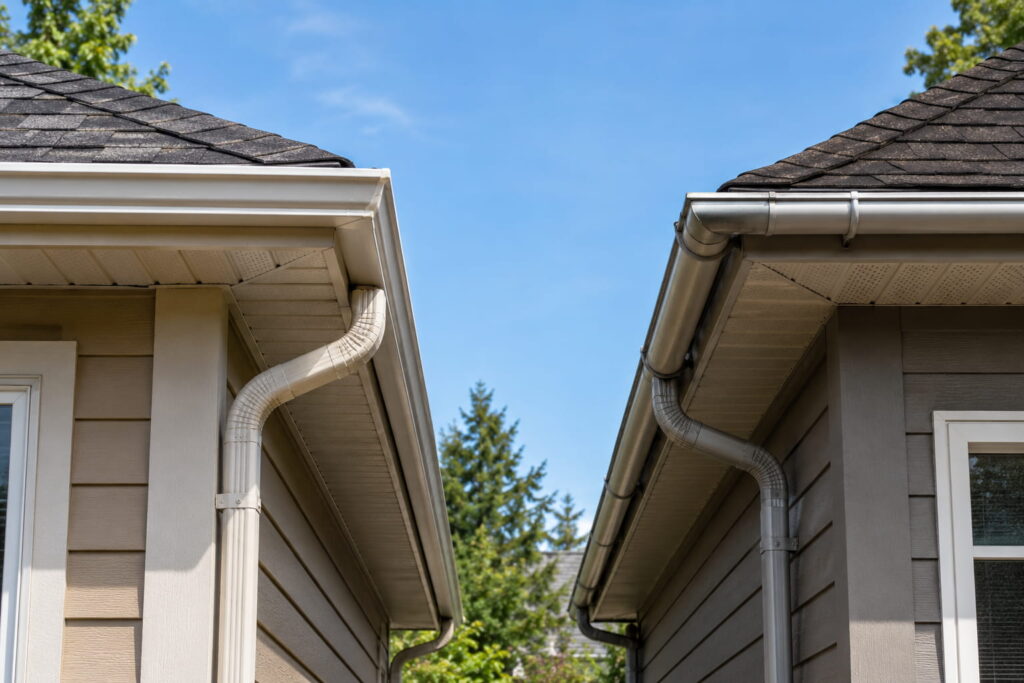
K-style and half-round are the two gutter profiles most commonly installed across the United States, and this gutter calculator's output applies to both, though the underlying capacity tables differ between them.
K-style gutters have a flat back with a more decorative front profile, and their flat bottom and near-vertical sides allow them to hold more water per inch of width than half-round gutters of the same nominal size. A 5 inch K-style gutter carries approximately 40 percent more capacity than a 5 inch half-round gutter despite the matching size label.
Half-round gutters use a smooth, rounded profile and appear most often on older homes, bungalows, and historic properties. Their shape allows debris to slide out more easily during cleaning, though they require a specialized hanger style and carry less overall volume than K-style profiles. Most new US construction uses K-style aluminum gutters, so confirm which profile your home currently has, or which one you intend to install, before applying the calculator's results.
Frequently Asked Questions
What is a gutter calculator?
A gutter calculator is a tool that determines the correct gutter size and downspout count for a roof, based on its drainage area, pitch, and local rainfall intensity. It removes the guesswork from purchasing materials or evaluating a contractor's quote.
How do I calculate how much gutter I need?
Measure the length of every eave that will receive a gutter and add those measurements together for your total linear footage. Use the gutter calculator to determine the correct size for each run based on the specific drainage area it serves.
What size gutter do I need for a 2,000 square foot roof?
A 2,000 square foot roof with a moderate pitch in a region with 2-inch-per-hour design rainfall typically requires a 5 inch K-style gutter with at least two downspouts. A pitch above 8:12 or a region receiving 3 or more inches per hour generally calls for a 6 inch gutter instead.
How far apart should downspouts be spaced?
Downspouts on a residential gutter system should be spaced no more than 20 to 40 feet apart. A 40 foot gutter run with two downspouts placed near each end represents a standard, safe installation
What happens if my gutters are too small?
Undersized gutters overflow during heavy rain, sending water down the side of the house instead of through the downspout system. Over time, this erodes soil near the foundation, stains siding, rots fascia boards, and can lead to basement or crawl space water intrusion.
Is a 4 inch gutter ever sufficient?
A 4 inch gutter works well for small drainage areas such as a detached garage, a shed, or a small addition with limited roof area. On a full-size single-family home, a 4 inch gutter is almost always undersized for the drainage load.
How does roof pitch affect gutter sizing?
A steeper roof increases both the speed at which water reaches the gutter and the effective drainage area used in sizing calculations. A 12:12 pitch (a 45-degree roof) has an effective drainage area approximately 41 percent larger than the same horizontal footprint on a flat roof, and the calculator applies this correction automatically.
I have a 1,800 square foot home. How many downspouts do I need?
The required count depends on how the gutter runs are arranged around the structure, not simply the home's total size. A 1,800 square foot home with gutters running along all four sides might have four separate runs, each requiring at least one downspout, with additional downspouts added for longer runs. Most homes this size end up with four to six downspouts total.
Does this gutter calculator work for commercial buildings?
This calculator is built around residential sizing standards. Commercial roofs frequently follow different design standards, including the SMACNA Architectural Sheet Metal Manual referenced in many commercial specifications. For commercial projects, confirm sizing with a licensed engineer or reference SMACNA guidelines directly.
Can this calculator be used for both K-style and half-round gutters?
Yes. Select the gutter style before entering your remaining inputs. The capacity tables applied in the background differ between K-style and half-round profiles, so this selection directly affects the final size recommendation.
Our Methodology
The calculator was created using industry-verified sources including the gutter capacity tables found in the International Residential Code (IRC), the SMACNA Architectural Sheet Metal Manual, which is a reference for commercial projects, as well as published engineering references and manufacturer specifications. All pricing data is compared to the current market information for 2026. These calculators are designed to help you plan accurately. Verify the results of any structural or drainage decision that will affect your home’s performance over time with a local building department or contractor.