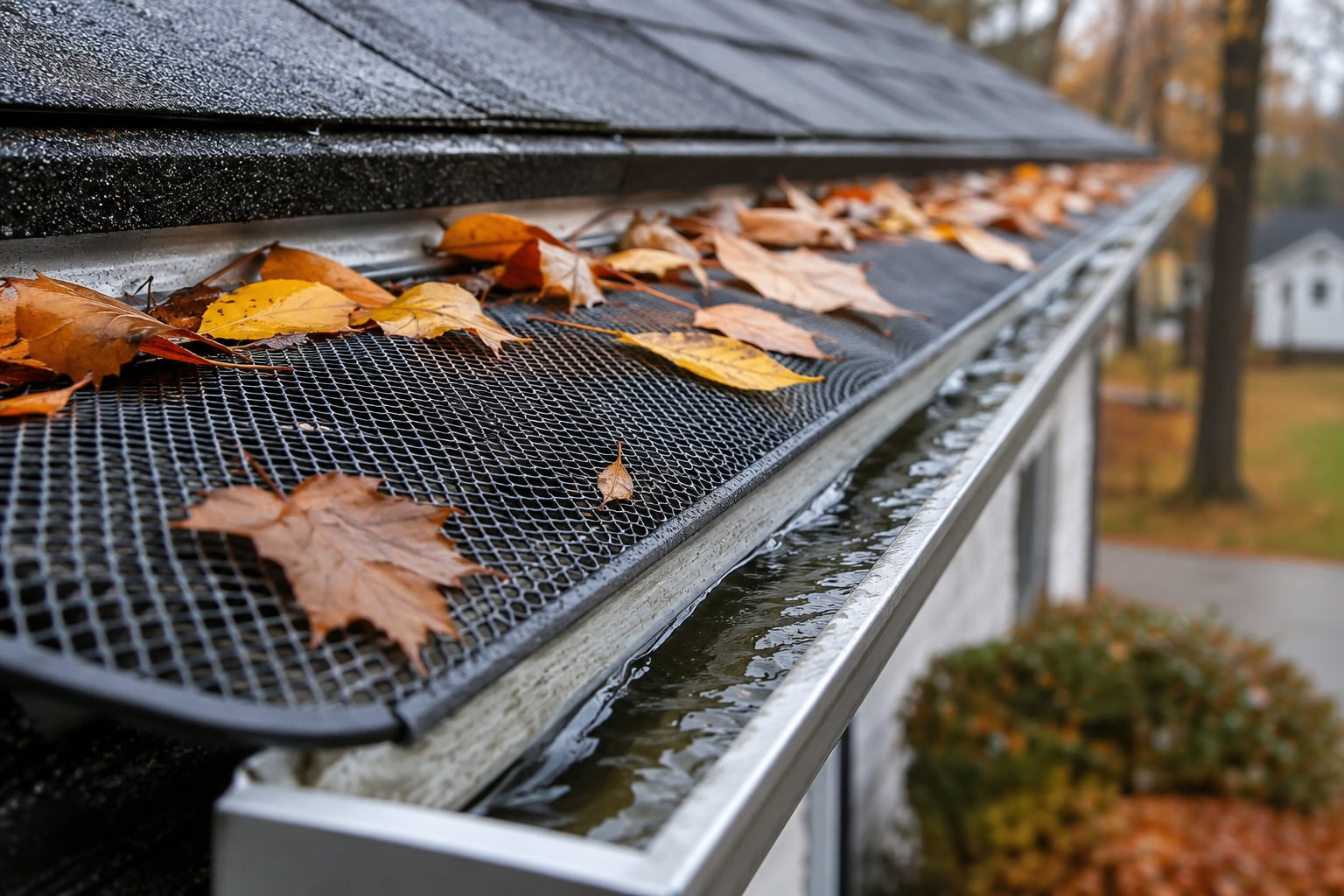
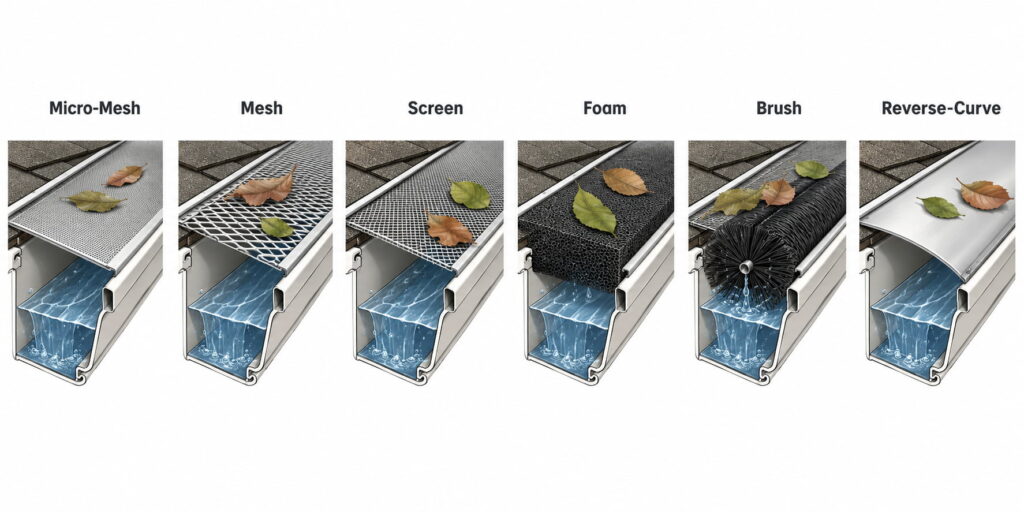
The six main types of gutter guards are micro-mesh, mesh, screen, foam, brush, and reverse-curve and the right one for your home depends mainly on the size of debris you get and your climate. Micro-mesh guards block the finest debris and perform best in heavy tree cover and snow mesh and screen guards handle typical leaves and twigs at a lower cost and foam and brush guards are the cheapest options but need replacing every few years. Reverse-curve guards shed the most water in heavy rain but are the most visible and expensive to install.
For most US homeowners with average tree cover a quality mesh or micro-mesh guard gives the best balance of protection and cost over time. For a light debris yard on a tight budget, screen or brush guards are a reasonable starting point as long as you accept more frequent maintenance. The sections below walk through each type, what it actually costs, which climates suit it and a decision framework so you can match a guard to your specific roof instead of guessing.
What is a gutter guard?
A gutter guard is defined as a cover or insert installed over or inside a gutter channel that blocks leaves, twigs, and other debris while allowing rainwater to pass through into the gutter and downspout system. Guards attach to the front lip of the gutter under the roof shingles or directly inside the trough, depending on the type.
The purpose is to reduce how often gutters need manual cleaning and to lower the chance of a clog causing an overflow. No gutter guard eliminates maintenance completely since even the finest mesh accumulates fine grit, pollen, and small seeds on its surface over time that still need occasional rinsing off.
What are the different types of gutter guards?
Gutter guards fall into six main categories and they differ mainly in hole size material and how they attach to the gutter. Moving from the smallest openings to the largest, in order of finest to coarsest filtration, the categories are micro-mesh meshh screen perforated surface guards, foam and brush inserts, and reverse-curve covers.
Micro-mesh guards use a stainless steel or aluminum mesh with openings typically measured in microns rather than fractions of an inch fine enough to block roof grit and pine needles as well as leaves.
Pros:
Blocks the finest debris of any guard type including pine needles and asphalt shingle grit
Typically carries the longest warranties in the category often 20 years or more from manufacturers
Performs consistently across snow heavy rain and high pollen conditions
Cons:
Costs the most per linear foot of any common guard type
Usually needs professional installation for a correct fit against the roofline
A clogged surface layer of very fine grit can still need an occasional rinse
Mesh guards use a slightly coarser metal or plastic mesh than micro-mesh with openings closer to a sixteenth to an eighth of an inch catching medium and large debris while letting most fine particles through.
Pros:
Costs noticeably less than micro-mesh while still blocking most leaves and twigs
Low profile and durable, often lasting decades with basic upkeep
Works across most US climates without special modification
Cons:
Lets fine debris like small seeds and grit through more often than micro-mesh
Some designs still require screws into the fascia, which is a consideration on older wood trim
Coarser mesh can sag slightly under heavy leaf load if not properly supported
Screen guards are flat panels with the largest openings of the mesh family, usually an eighth to a quarter inch, sold widely at home improvement stores as an affordable, do it yourself option.
Pros:
The cheapest guard type that still meaningfully blocks large leaves
Simple to cut and install without professional help on most gutter profiles
Widely available and easy to replace a damaged section
Cons:
Smaller debris like maple seeds sweet gum balls and pine needles pass through easily
Requires more frequent surface cleaning than mesh or micro-mesh
Thinner materials can bend or lift in high wind
Foam inserts are porous triangular or rectangular pieces that fit directly inside the gutter channel letting water soak through while blocking larger debris on top.
Pros:
Among the cheapest guard types to buy
No tools or roof access needed since they simply drop into the channel
Simple for a homeowner to install in an afternoon
Cons:
Typically needs replacing every 3 to 5 years as the material breaks down under UV exposure
Retains moisture inside the porous material which can promote mold or algae growth in humid climates
Can restrict water flow during very heavy rain once saturated the opposite of what a guard should do
Brush guards are cylindrical bristle inserts that sit inside the gutter similar in concept to a giant pipe cleaner, letting water flow around the bristles while catching debris on top.
Pros:
Very easy to install and remove for cleaning without tools
Handles pine needles reasonably well compared to foam or basic screens
No professional installation required
Cons:
Small debris and seeds work down between the bristles and accumulate at the bottom over time
Bristles degrade and become brittle with UV and temperature exposure typically needing replacement within several years
Cleaning requires removing the entire brush rather than simply rinsing the gutter
Reverse-curve guards, also called surface tension guards are solid covers with a curved lip that uses water adhesion to pull rain down and around the curve into the gutter while shedding debris off the front edge.
Pros:
Handles very heavy rainfall and high water volume better than most mesh or screen types
Fully covers the gutter opening, keeping out even large debris like branches
Long lifespan since there is no mesh or bristle material to degrade
Cons:
The most visible guard type from the ground, which affects curb appeal
Almost always requires professional installation for the curve to align correctly with roof pitch
In icy climates, ice can form along the curve and block the water path entirely
How much do gutter guards cost by type?
Gutter guard costs vary by type, material, and whether installation is professional or DIY, typically ranging from about $1 to $10 per linear foot for materials alone as commonly reported by suppliers in 2026. Professionally installed systems especially micro-mesh and reverse-curve types commonly run higher once labor is included.
Guard type
Typical material cost per linear foot
Typical installed cost per linear foot
Installation
Screen
$1 to $3
$3 to $6
DIY friendly
Mesh
$2 to $5
$6 to $12
DIY or professional
Foam
$1 to $3
$2 to $4 (DIY)
DIY
Brush
$2 to $4
$3 to $6 (DIY)
DIY
Micro-mesh
$4 to $10
$15 to $25
Usually professional
Reverse-curve
$5 to $8
$12 to $20
Professional
For a typical single-family home with 150 to 200 linear feet of gutter, that translates to roughly $450 to $1,200 for a DIY screen or brush installation, versus $2,250 to $5,000 for a professionally installed micro-mesh system, as commonly reported by suppliers and installers in 2026. Prices fluctuate with material costs and regional labor rates, so treat these as planning ranges and confirm current pricing with local suppliers before budgeting a specific project.
Which gutter guard works best for your climate and trees?
The right gutter guard depends more on what falls on your roof than on your general climate zone, since a home under pine trees needs different protection than one under oak or maple. Matching the guard to your specific debris and weather pattern matters more than picking the single most expensive option available.
Situation
Best guard type
Why
Heavy pine needle drop
Micro-mesh
Fine mesh blocks needles that pass through screen or brush
Broad leaf trees (oak, maple)
Mesh or screen
Larger leaves are caught effectively by coarser openings
Low absorption and rigid frame resist ice buildup better than foam or brush
Hot, dry, low debris areas
Screen or foam
Lower cost is justified when debris load is light
Humid climates
Mesh or micro-mesh
Avoids the mold and moisture retention foam is prone to
Tight budget, DIY preferred
Screen or brush
Lowest cost and no professional installation required
Foam guards are the type most likely to underperform outside of dry low humidity climates since the same porous material that blocks debris also holds moisture. In consistently humid regions, that trapped moisture creates conditions for mold and mildew inside the gutter itself which defeats part of the guard’s purpose.
Are gutter guards worth it?
Gutter guards are worth it for most homeowners with moderate to heavy tree cover because they meaningfully reduce how often gutters need cleaning and lower the risk of the overflow damage that comes from a clogged unprotected system. They are a weaker value for homes with very little nearby tree cover where gutters rarely clog in the first place.
The value case rests on what an overflow actually costs. A clogged gutter that overflows repeatedly can erode soil at the foundation rot fascia boards, and in worse cases contribute to basement water intrusion damage that regularly costs far more to repair than any gutter guard system costs to install. Weighed against a $500 foundation-related repair or a $3,000 basement moisture problem even a premium micro-mesh installation is inexpensive insurance.
The value case gets weaker in three situations. A home with no large trees within falling distance may see a gutter guard as an unnecessary expense since there is little debris to block in the first place. A homeowner who already cleans gutters twice a year without issue may find the cost hard to justify purely on convenience. And a homeowner who installs guards but then never checks them again can still end up with an overflow since every guard type needs occasional inspection even if it needs it less often than an unprotected gutter.
One connection matters more than most sellers mention a gutter guard cannot fix an undersized gutter. If the gutter itself is too small for the roof’s drainage load adding a guard on top does not increase its water carrying capacity, and the system can still overflow during a heavy storm even with debris fully blocked. Before adding guards confirm your existing gutter size is correct for your roof using the Gutter Calculator on this site, since a correctly sized gutter is the foundation any guard sits on top of.
Which gutter guard should you choose? A decision framework
If you have pine trees near your roof, choose micro-mesh, because needles pass through every other guard type and are the debris most likely to cause a slow hidden clog.
If you have broad leaf trees like oak or maple and a moderate budget, choose mesh, because it blocks the majority of leaf debris at a meaningfully lower cost than micro-mesh.
If your yard has very little tree cover, choose screen or skip guards entirely, since the cost of any guard type is harder to justify when there is little debris to block.
If your region sees heavy, sustained rainfall, choose reverse-curve or a quality mesh system, since both handle high water volume better than foam or brush during an intense storm.
If you live somewhere with real winters and ice, choose micro-mesh over foam or brush, since foam retains moisture that can freeze and brush bristles become brittle in repeated freeze cycles.
If your budget is the deciding factor and you are comfortable with more frequent maintenance, choose screen or brush, since both keep upfront cost low in exchange for shorter service life and more attention.
If you are unsure whether your existing gutters are even the right size before adding any guard, run your roof dimensions through the Gutter Calculator on this site first, since undersized gutters overflow with or without a guard installed.
What are common mistakes when choosing gutter guards?
Choosing the cheapest guard without checking debris type is the most common mistake. A homeowner under pine trees who installs basic screen guards because they are inexpensive often ends up cleaning needles off the surface almost as often as they cleaned the open gutter before, since needles pass straight through screen openings.
Assuming any guard is maintenance free leads to bigger problems later. Every guard type accumulates some debris on its surface over time, and skipping annual inspection can let a partially blocked guard cause an overflow that goes unnoticed until damage appears.
Installing foam or brush guards in a humid or snowy climate ignores how those materials perform under real conditions. Foam retains moisture that promotes mold in humid regions, and both foam and brush degrade faster under repeated freeze and thaw cycles than mesh or micro-mesh.
Adding gutter guards to an undersized gutter system treats the symptom instead of the cause. If the underlying gutter cannot carry the roof’s water load during a heavy storm, no guard on top changes that, and confirming gutter size first prevents paying for guards that get blamed for a problem they did not cause.
Skipping professional installation on guard types that need precise alignment causes early failures. Reverse-curve and premium micro-mesh systems depend on exact positioning against the roof pitch, and a poor DIY fit can let water miss the gutter entirely during heavy rain.
Ignoring the downspouts while focusing only on the gutter run leaves half the system unprotected. Debris that gets past a guard, or accumulates at outlet points, can still clog a downspout, so any gutter guard installation should include downspout strainers or covers at each outlet.
Frequently asked questions
What are the main types of gutter guards?
The six main types of gutter guards are micro-mesh, mesh, screen, foam, brush, and reverse-curve, each differing mainly in hole size and how they attach to the gutter. Micro-mesh blocks the finest debris and costs the most, while foam and brush are the cheapest but need replacement every few years.
Which type of gutter guard is best?
The best type of gutter guard depends on your debris load and climate, with micro-mesh generally performing best for pine needles, snow, and heavy tree cover, and mesh or screen offering good value for typical leaf debris on a tighter budget. No single type is best for every home, since the right choice depends on what actually falls on your roof.
Are gutter guards worth it?
Gutter guards are worth it for most homes with moderate to heavy tree cover, since they reduce cleaning frequency and lower the risk of overflow damage that often costs more to repair than the guards cost to install. They are a weaker value on homes with very little nearby tree cover, where gutters rarely clog without protection.
How much do gutter guards cost?
Gutter guard costs typically range from about $1 to $10 per linear foot for materials depending on type, with professionally installed micro-mesh or reverse-curve systems commonly running $15 to $25 per linear foot installed, as commonly reported by suppliers in 2026. A typical home needs 150 to 200 linear feet of gutter guard coverage.
Do gutter guards really work?
Yes, gutter guards work to significantly reduce how much debris enters the gutter and how often manual cleaning is needed, though no guard type eliminates maintenance completely. Fine debris like pollen and shingle grit can still collect on top of even the best micro-mesh guard and needs an occasional rinse.
What is the difference between mesh and micro-mesh gutter guards?
Mesh guards use larger openings, typically a sixteenth to an eighth of an inch, while micro-mesh uses much finer openings measured in microns that block pine needles and roof grit in addition to leaves. Micro-mesh costs more and usually needs professional installation while standard mesh is more budget friendly and often DIY installable.
I have pine trees all around my house and get ice in the winter. What type of gutter guard should I get?
Micro-mesh is the strongest choice for your situation, because it blocks fine pine needles that pass through screen and brush guards, and it holds up better than foam or brush under repeated winter freeze and thaw cycles. Confirm the product carries a cold climate rating and consider professional installation to ensure a tight seal against ice.
My gutters overflow even though I just installed screen guards. What is going on?
Your overflow is likely caused by either the wrong guard type for your debris or an undersized gutter rather than a guard failure. Screen guards let smaller debris like seeds and pine needles through, and if your gutter itself is too small for your roof’s drainage area, no guard changes that; running your dimensions through the Gutter Calculator on this site will confirm whether the gutter size itself is the real problem.
Can I install gutter guards myself?
Yes, screen, foam, and brush guards are generally DIY friendly and require no special tools beyond basic cutting and fitting. Micro-mesh and reverse-curve systems usually call for professional installation, since both depend on precise alignment with the roof pitch to work correctly.
How long do gutter guards last?
Foam and brush guards typically last 3 to 5 years before needing replacement, while mesh and screen guards commonly last 10 to 20 years, and micro-mesh and reverse-curve systems often carry 20 year to lifetime warranties from manufacturers. Actual lifespan depends on climate exposure and how much debris the guard handles over time.
The bottom line
Every gutter guard type trades cost against filtration and maintenance, and the right choice comes down to what actually falls on your roof and how much upkeep you want to do. Micro-mesh earns its higher price under pine trees and in snowy climates, mesh and screen cover most typical leaf situations at a lower cost, and foam and brush suit a tight budget as long as you accept shorter lifespans and more attention. None of it matters if the gutter underneath is the wrong size, so confirm that first, then choose the guard that matches your trees, your climate, and how much maintenance you are willing to do. This guide is built for informed decision making; for a binding installation quote, always consult a licensed local contractor.
The most common types of roof trusses are Fink, Howe, Scissor, Attic, Mono, Queen Post, King Post, and Hip trusses. The right one for your project depends on a few things. These include your roof span. They also include your ceiling style. And they include whether you need extra storage or living space above. Fink…
Here is how to measure a roof for shingles in four steps. Find your building’s exterior length and width. Add your eave overhang. Apply a pitch correction for slope. Convert the total into roofing squares. You can do this from the ground with a tape measure and a level. You can also do it from…
A gambrel roof design is the right choice when you want the most usable upper floor space for your money, which is why it dominates barns, storage sheds, and Dutch Colonial homes across the US. Builders commonly estimate that a gambrel delivers roughly 40 to 50 percent more usable upper level space than a gable…
Metal Roof vs Asphalt Shingles is one of the most important comparisons for homeowners planning a roof replacement in 2026. Asphalt shingles cost less upfront and remain the practical choice for most homeowners on a standard budget or planning to sell within 10 years. Metal roofing costs two to five times more to install but…
Most homes can hold about 20 pounds of snow per square foot before the roof feels stressed. That works out to roughly 4 feet of fresh, fluffy snow. Or about 2 feet of old, packed snow. That number is not fixed for every roof. It shifts based on your roof’s age, pitch, and material. It…
A low pitch roof has a shallow slope. It generally sits between flat and a standard 4:12 pitch. It needs different materials, ventilation, and waterproofing than a steep roof. Most sources place the low slope cutoff between 2:12 and 4:12. OSHA sets its own regulatory line at 4:12 for fall protection purposes. Asphalt shingles work…