Metal Roof vs Asphalt Shingles is one of the most important comparisons for homeowners planning a roof replacement in 2026. Asphalt shingles cost less upfront and remain the practical choice for most homeowners on a standard budget or planning to sell within 10 years. Metal roofing costs two to five times more to install but lasts two to three times longer, uses less energy to cool, and holds up better in severe weather, making it the stronger long-term choice for homeowners planning to stay put or living in a harsh climate. The right option depends on your budget, climate, and how long you plan to keep your home. This guide compares cost, lifespan, durability, maintenance, energy efficiency, and resale value to help you choose the best roofing material.
What Is the Real Difference Between a Metal Roof and Asphalt Shingles?
A metal roof is a roofing system made from interlocking steel, aluminum, copper, or zinc panels or shingles, installed as large sheets or individual pieces over a structural deck. Asphalt shingles are a layered roofing product made from a fiberglass mat coated in asphalt and topped with mineral granules, installed as individual overlapping pieces starting at the eave. The two systems differ in material, installation method, weight, expected lifespan, and price, which is why they suit different homeowners and different climates.
Which Roofing Material Lasts Longer?
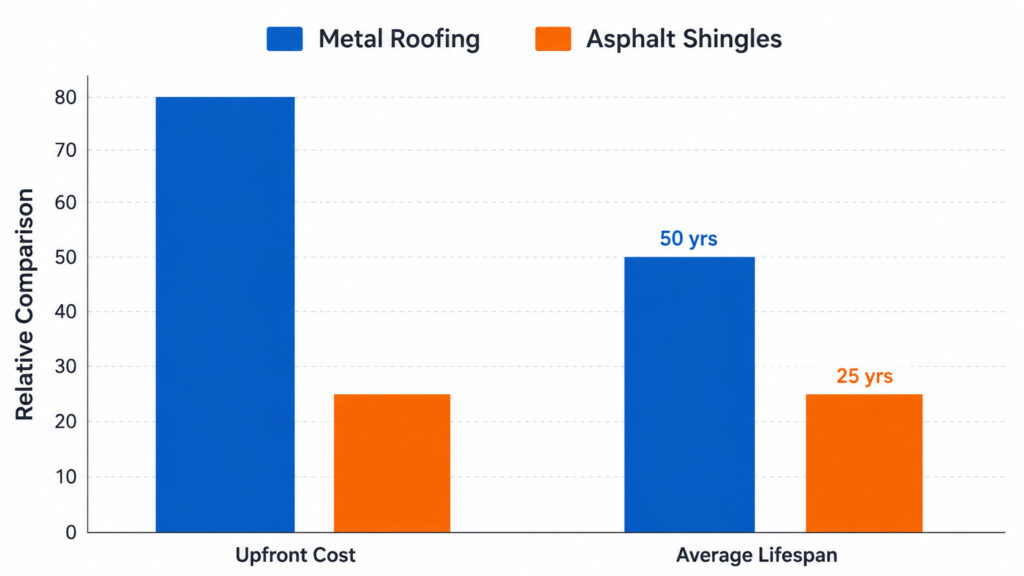
A metal roof typically lasts 40 to 70 years, while asphalt shingles typically last 15 to 30 years depending on the shingle grade and climate. Standing seam and premium coated metal panels sit at the top of that metal range, while corrugated exposed-fastener panels sit toward the lower end. A shingle rated for 30 years by its manufacturer often delivers closer to 24 to 25 years of real-world service once granule loss, thermal cracking, and storm damage are factored in, which is a gap worth planning around rather than assuming the rated number is guaranteed.
Material
Typical Lifespan
Common Warranty Length
3-tab asphalt shingles
15 to 25 years
20 to 25 years
Architectural asphalt shingles
25 to 30 years
30 years
Corrugated or exposed-fastener metal
25 to 40 years
20 to 30 years
Standing seam steel or aluminum
40 to 70 years
30 to 50 years
Copper standing seam
70 to 100+ years
Often uncoated, no standard warranty
Asphalt Shingles: Pros and Cons
Pros:
Lower upfront cost than any metal roofing option
Fast installation using tools and techniques familiar to almost every roofing contractor in the country
Wide range of colors and styles to match almost any architectural look
Naturally dampens rain and hail noise better than bare metal
Cons:
Shortest lifespan of any common roofing material, typically 15 to 30 years
More vulnerable to cracking in climates with large day-to-night temperature swings
Granule loss and algae staining are common as the roof ages
Usually needs full tear-off and replacement rather than a simple recoat once it fails
Metal Roofing: Pros and Cons
Pros:
Lasts two to three times longer than asphalt shingles in most climates
Reflects solar heat, which can lower cooling costs in hot climates
Handles high wind, hail, and wildfire exposure better than standard asphalt
Fully recyclable at the end of its service life
Cons:
Costs two to five times more than asphalt shingles to install
Requires specialized tools and experienced installers, which limits your contractor pool in some areas
Can be noisier than asphalt during heavy rain or hail without proper solid decking and underlayment
Panels can dent from large hail or falling branches, and a dented panel is more visible on light-colored or reflective finishes
How Much Does Each Roofing Material Cost in 2026?
Asphalt shingles typically cost 1 to 4 dollars per square foot installed, while metal roofing typically costs 4 to 30 dollars per square foot installed depending on the panel type. Three-tab shingles sit at the low end of the asphalt range and architectural shingles sit at the higher end. Corrugated exposed-fastener metal sits at the low end of the metal range, while standing seam, metal shingle, and copper systems sit progressively higher.
Material
Installed Cost per Square Foot (2026)
Installed Cost, 2,000 sq ft Roof
3-tab asphalt shingles
$1 to $2.50
$2,000 to $5,000
Architectural asphalt shingles
$2.50 to $4
$5,000 to $8,000
Corrugated or exposed-fastener metal
$4 to $7
$8,000 to $14,000
Standing seam steel or aluminum
$8 to $16
$16,000 to $32,000
Copper standing seam
$25 to $50+
$50,000 to $100,000+
These figures reflect typical 2026 market ranges as commonly reported by roofing contractors and suppliers across the US. Material costs move with steel, aluminum, and asphalt commodity markets, and labor rates vary significantly by region, so always confirm current pricing with a local supplier before budgeting. If you want an estimate specific to your own roof, our Metal Roof Calculator and Shingle Calculator both convert your building dimensions and pitch into material quantities and a cost range for your exact project.
What Does Each Material Actually Cost Over 40 Years?
The cheaper material upfront is not always the cheaper material over time, because asphalt shingles need to be replaced multiple times within the lifespan of a single metal roof. Here is a worked example using real numbers for a 2,000 square foot roof.
Scenario: A homeowner plans to keep their house for 40 years and compares architectural asphalt shingles against standing seam steel.
Step
Asphalt Path
Metal Path
Year 0 install
$6,500
$22,000
Year 27 replacement
$7,500 (updated pricing)
Not needed
Total material cost over 40 years
$14,000
$22,000
Tear-off and disposal (per install)
$1,500 to $2,500 each time
Not needed, often installed over existing deck
Even with one full replacement included, asphalt can still come out cheaper in raw material and labor cost over a 40 year window in this example, which is why upfront budget remains a legitimate reason to choose shingles. The gap narrows considerably once energy savings, avoided tear-off costs, and avoided disruption from a second full reroofing project are factored in, and it can flip in favor of metal for homeowners in hot climates where the cooling savings are largest. Run your own numbers based on your local material and labor pricing rather than relying on a single generic example, since regional cost swings of 30 percent or more are common.
Which Roofing Material Holds Up Better in Extreme Weather?
Metal roofing generally outperforms asphalt shingles in high wind, hail, heavy snow, and wildfire exposure, while asphalt performs adequately in moderate climates without extreme weather risk. Metal panels are rated for wind speeds that exceed most residential asphalt shingle wind ratings, and metal is non-combustible, which matters directly in wildfire-prone regions. Heavy hail can dent metal panels, though impact-resistant Class 4 asphalt shingles can close much of that gap for homeowners who want hail resistance without the metal price tag.
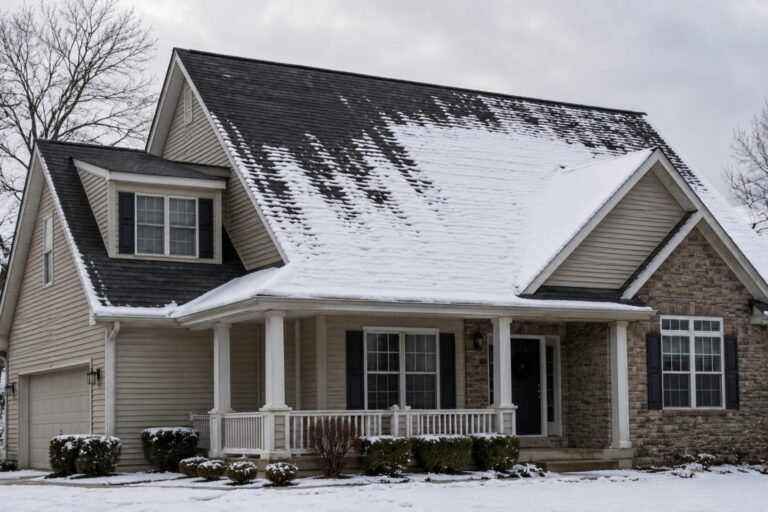
Snow tends to slide off a metal roof more easily than off asphalt shingles because of its smooth, low-friction surface, which reduces the standing snow load an older structure has to carry. If you are unsure whether your existing framing can handle a heavier snow load in your region, our Roof Load Calculator walks through dead, live, snow, and wind load together so you can check before committing to either material.
Does Your Roofing Material Affect Your Energy Bills?
A reflective metal roof can lower cooling costs in hot climates, while asphalt shingles tend to perform slightly better at retaining heat in cold climates. Light-colored or specially coated metal panels reflect a significant portion of solar heat rather than absorbing it, which is why metal roofs are common in hot Southern and Southwestern states. In colder climates, dark asphalt shingles absorb more heat, which can modestly reduce heating demand in winter, though this effect is smaller than the cooling benefit metal offers in hot regions.
Does a Metal Roof Really Increase Resale Value More Than Shingles?
Both a new metal roof and a new asphalt shingle roof increase resale value, but the reported return on investment varies by source and does not point to one clear winner. Remodeling Magazine’s annual Cost vs. Value Report, a widely cited industry benchmark, has shown asphalt shingle replacements recouping a higher percentage of their cost than metal roof replacements in several recent editions, since the dollar amount spent on asphalt is much smaller to begin with. Other industry sources report metal roofs adding a larger dollar increase to resale value and recouping a comparable or higher percentage in specific markets, particularly in regions where buyers actively look for long-lasting, low-maintenance roofing.
The honest takeaway is that a new roof of either material helps resale value more than an old, worn roof of any material, and the exact percentage recouped depends heavily on your local market, buyer expectations, and how long you plan to live in the home before selling. Homeowners planning to sell within the next 5 years often get a better return from a well-installed asphalt roof simply because the upfront cost is lower relative to the value it adds.
Which Roofing Material Needs Less Maintenance?
Metal roofing generally requires less routine maintenance than asphalt shingles once it is properly installed. Asphalt shingles benefit from an inspection after every major storm, since wind and hail can lift or crack individual shingles that need prompt patching to prevent water intrusion. Metal roofs mainly need periodic checks of fastener integrity on exposed-fastener systems and occasional clearing of debris from valleys, but the panels themselves rarely need patching the way individual shingles do.
Is a Metal Roof Louder Than Asphalt Shingles in the Rain?
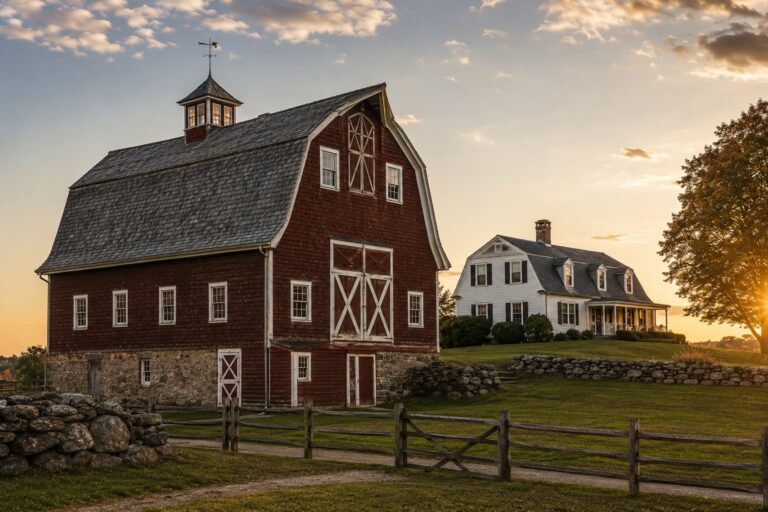
A metal roof installed over solid decking with standard underlayment is not significantly louder than an asphalt shingle roof during rain. Roofing contractors commonly report the real-world difference at around 8 decibels once solid plywood or OSB sheathing, underlayment, and attic insulation are in place, a gap most homeowners do not notice as meaningfully different from asphalt shingles in everyday use. The perception that metal roofs are loud mostly comes from older exposed-rafter barn and agricultural buildings without solid sheathing or insulation underneath the panels, where the difference is far more pronounced. Very heavy hail can still be audible on either material, but this affects both roofing types rather than being unique to metal.
Which Roofing Material Is Better for the Environment?
Metal roofing is generally the more environmentally favorable option because it is fully recyclable at the end of its service life and often contains recycled content when manufactured. Asphalt shingles are petroleum-based, and according to the U.S. Department of Transportation, roughly 11 million tons of asphalt shingles are sent to US landfills every year, since shingle recycling infrastructure remains limited in most parts of the country as of 2026. Metal’s much longer lifespan also means fewer total roofing replacements over the life of a home, which reduces the cumulative material and manufacturing footprint compared to replacing an asphalt roof two or three times over the same period.
Does Roofing Material Affect Pest Resistance or Coastal Durability?
Metal roofing resists pests such as mice, rats, and wood-boring insects better than asphalt shingles, since there is no organic material for pests to nest in or chew through. This matters most for homes near wooded areas or in regions with heavy rodent or termite pressure, where asphalt’s fiberglass mat and granule surface offer no particular resistance either way. For homes in coastal or high-salt-exposure areas, aluminum and zinc panels resist salt corrosion better than uncoated steel, so the specific metal matters as much as the choice between metal and asphalt; a coastal homeowner set on metal roofing should ask installers about aluminum or zinc rather than defaulting to steel.
Some insurers offer a modest discount for impact-resistant roofing, which can include either Class 4 rated metal panels or Class 4 rated impact-resistant asphalt shingles, so the discount is tied to the impact rating rather than the material itself in many policies. In hail-prone states, insurers increasingly ask about roof age and material condition when setting premiums or renewing coverage, and a newer roof of either material in good condition generally receives more favorable treatment than an aging roof nearing the end of its expected life. Contact your specific insurer before assuming either material automatically lowers your premium, since discount programs and underwriting rules vary significantly by company and state.
How Do I Decide Between Metal and Asphalt Shingles for My Home?
Choose asphalt shingles if your budget is the primary constraint, you plan to sell within the next 5 to 10 years, or you live in a moderate climate without frequent severe hail, wildfire, or hurricane-force wind exposure. Choose metal roofing if you plan to stay in the home long term, live in a region with harsh winters, high wind, wildfire risk, or intense summer heat, or want to minimize the number of times you have to reroof over the decades you own the house.
Your Priority
Better Choice
Lowest possible upfront cost
Asphalt shingles
Planning to sell within 5 years
Asphalt shingles
Staying 20+ years in a harsh climate
Metal roofing
Wildfire-prone area
Metal roofing
Hot climate, high cooling bills
Metal roofing
Matching a traditional architectural style at low cost
Asphalt shingles
Minimizing lifetime maintenance calls
Metal roofing
Once you know which direction fits your situation, our Metal Roof Calculator or Shingle Calculator can turn your building’s exact dimensions and pitch into a material quantity and cost estimate for your specific roof.
What Mistakes Do Homeowners Make When Choosing Between These Two?
Assuming the advertised warranty length equals the real-world lifespan is one of the most common mistakes, since asphalt shingles rated for 30 years commonly deliver closer to 24 to 25 years in practice depending on climate and installation quality. Comparing only the upfront installed price without factoring in how many times an asphalt roof will need replacement over the same period as one metal roof leads to an incomplete cost picture, especially for homeowners planning to stay in the house for several decades.
Assuming metal roofing is always noisy is another common misconception, when in practice a properly decked and insulated metal roof performs similarly to shingles in normal rain. Choosing a roofing material based on resale value alone is also risky, since the reported return on investment for both materials varies significantly by source, region, and local buyer expectations, and no single number applies universally. Finally, assuming any insurance discount is automatic is a mistake, since discounts are typically tied to a specific impact rating and require confirmation from your individual insurer rather than the roofing material name alone.
Frequently Asked Questions
Is a metal roof worth the extra cost compared to asphalt shingles?
A metal roof is worth the extra cost for homeowners planning to stay in their home long term or living in a harsh climate, since it lasts two to three times longer and can lower cooling costs in hot regions. For homeowners on a tight budget or planning to sell within a few years, asphalt shingles often deliver better value relative to the shorter time horizon.
How much more expensive is a metal roof than asphalt shingles?
Metal roofing typically costs two to five times more than asphalt shingles to install, with standing seam steel running roughly $8 to $16 per square foot installed compared to $1 to $4 per square foot for asphalt shingles. The exact gap depends on the specific metal panel type and asphalt shingle grade being compared.
How long does a metal roof last compared to asphalt shingles?
A metal roof typically lasts 40 to 70 years while asphalt shingles typically last 15 to 30 years, meaning a single metal roof can outlast two to three asphalt shingle roofs installed back to back. Standing seam and premium coated panels sit at the higher end of the metal lifespan range.
Does a metal roof make more noise than shingles during rain?
A metal roof installed with solid decking and standard underlayment is not significantly louder than asphalt shingles during normal rain. The loud metal roof reputation mostly comes from older barn-style buildings without solid sheathing or insulation underneath the panels.
Does installing solar panels work better with a metal roof or asphalt shingles?
Solar panels can be mounted on either roofing material, but a metal roof, especially standing seam, allows clamp-on mounting systems that do not require penetrating the roof surface, unlike most asphalt shingle installations. A metal roof’s longer lifespan also means you are less likely to need a full reroof partway through your solar panel’s 25 to 30 year expected life, avoiding the extra cost of removing and reinstalling panels for a roof replacement. If you already have a roof, check its remaining lifespan against your planned solar system’s warranty period before committing to either mounting approach.
I live somewhere with harsh winters and hail, should I get metal or shingles?
Metal roofing is generally the stronger choice for harsh winters and hail exposure, since it sheds snow more easily and standing seam or Class 4 rated panels resist hail impact better than standard asphalt. If budget is the deciding factor, Class 4 impact-resistant asphalt shingles offer a middle ground with better hail resistance than standard shingles at a lower cost than metal.
Does a metal roof lower my homeowners insurance premium?
Some insurers offer a discount for Class 4 impact-resistant roofing, which applies to certain metal panels and certain impact-rated asphalt shingles, so the discount depends on the impact rating rather than the material name alone. Contact your specific insurance provider to confirm whether your chosen product qualifies for any discount in your state.
If my roof pitch is very low, does that decide the material for me?
Yes, a very low roof pitch can rule out standard asphalt shingles entirely and make metal or a membrane system your only practical option. Standard asphalt installation generally needs at least 4:12, or 2:12 with double underlayment under IRC Section R905.2, so anything below that threshold pushes you toward low-slope metal panels or a membrane roof rather than a genuine metal-versus-asphalt choice. If your pitch sits above both materials’ minimums, the decision comes down to the budget and climate factors covered earlier in this guide rather than a code restriction. Our Roof Pitch Calculator can confirm your exact pitch before you rule either option in or out.
Is it cheaper in the long run to replace asphalt shingles twice or install one metal roof?
For many 30 to 40 year ownership timelines, replacing asphalt shingles once or twice can still come out cheaper in raw material and labor cost than a single metal roof installation, though the gap narrows once energy savings and avoided tear-off costs are included. The better long-run value depends heavily on local material pricing, your climate’s cooling demand, and how many total years you plan to own the home.
Do metal roofs attract lightning strikes?
Metal roofing does not attract lightning any more than other roofing materials, since lightning is drawn to the tallest point and best grounding path in an area rather than the roofing material itself. If lightning does strike a metal roof, the non-combustible material actually reduces fire risk compared to a strike on a combustible roofing material.
Final Thoughts
Neither material is universally better, and the right choice depends on your specific budget, climate, and how long you plan to stay in the home. Asphalt shingles remain the practical default for most US homeowners because of their lower upfront cost and wide contractor availability, while metal roofing earns its higher tag through a much longer service life, better severe weather performance, and lower long-term maintenance. Once you have picked a direction, our Metal Roof Calculator and Shingle Calculator can turn your building’s exact measurements into a material quantity and cost estimate for your project.
Our research team compared industry cost data, manufacturer lifespan claims, and building code requirements from the International Residential Code to build this comparison. Cost and lifespan figures reflect typical 2026 market ranges as commonly reported by roofing contractors and suppliers, and actual figures vary by region, installer, and product line. This guide is built for informed decision making, and for a binding quote or a structural determination specific to your home, always consult a licensed local contractor.
A gambrel roof design is the right choice when you want the most usable upper floor space for your money, which is why it dominates barns, storage sheds, and Dutch Colonial homes across the US. Builders commonly estimate that a gambrel delivers roughly 40 to 50 percent more usable upper level space than a gable…
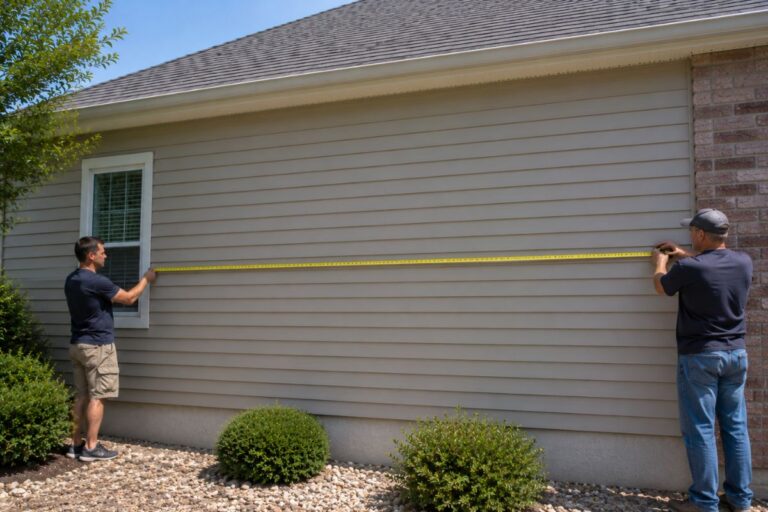
Here is how to measure a roof for shingles in four steps. Find your building’s exterior length and width. Add your eave overhang. Apply a pitch correction for slope. Convert the total into roofing squares. You can do this from the ground with a tape measure and a level. You can also do it from…
Most homes can hold about 20 pounds of snow per square foot before the roof feels stressed. That works out to roughly 4 feet of fresh, fluffy snow. Or about 2 feet of old, packed snow. That number is not fixed for every roof. It shifts based on your roof’s age, pitch, and material. It…
A low pitch roof has a shallow slope. It generally sits between flat and a standard 4:12 pitch. It needs different materials, ventilation, and waterproofing than a steep roof. Most sources place the low slope cutoff between 2:12 and 4:12. OSHA sets its own regulatory line at 4:12 for fall protection purposes. Asphalt shingles work…
The most common types of roof trusses are Fink, Howe, Scissor, Attic, Mono, Queen Post, King Post, and Hip trusses. The right one for your project depends on a few things. These include your roof span. They also include your ceiling style. And they include whether you need extra storage or living space above. Fink…
The six main types of gutter guards are micro-mesh, mesh, screen, foam, brush, and reverse-curve and the right one for your home depends mainly on the size of debris you get and your climate. Micro-mesh guards block the finest debris and perform best in heavy tree cover and snow mesh and screen guards handle typical…